






Blogs
Insights, innovations, and news from the world of casters.
Latest Post
How to Calculate Load Capacity for Industrial Caster Wheels in India
Published on Nov 24, 2025
Category Blogs
Top 5 Heavy-Duty Caster Wheels for Industrial Use in 2025
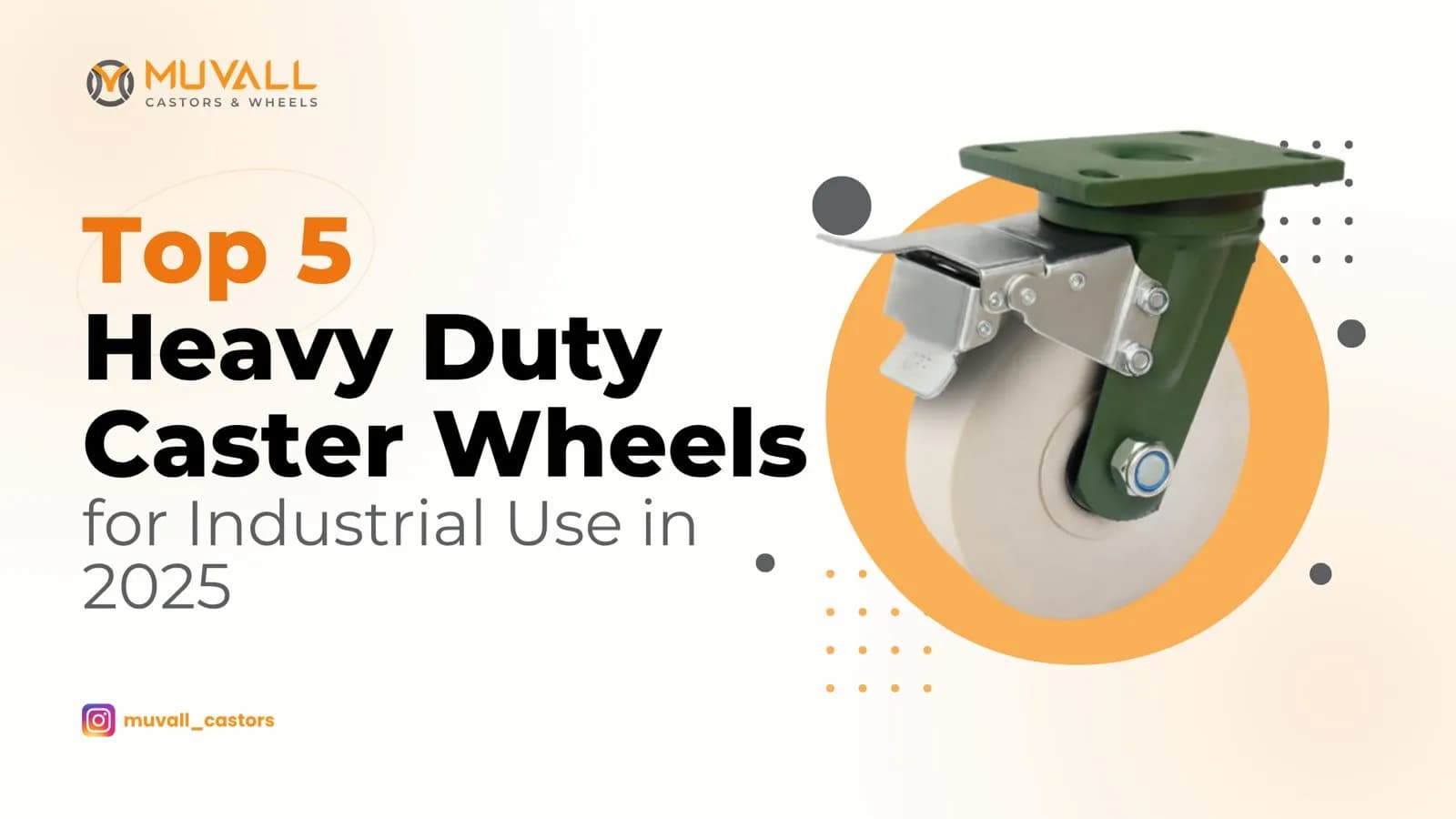
India’s manufacturing, logistics, and warehousing sectors are scaling faster than ever, and along with this growth comes the need for stronger, safer, and more reliable industrial mobility systems. Whether you’re moving dies, molds, CNC equipment, automated platforms, or heavy assemblies, choosing the right heavy-duty castor wheel directly impacts uptime, operator safety, and productivity. With over a decade of engineering excellence, Muvall Castors Pvt. Ltd. continues to lead India’s industrial castor market through precision manufacturing, ISO 9001-certified quality processes, and superior load-engineered designs. This 2025 guide presents the Top 5 Heavy-Duty Caster Wheels, fully updated with accurate load ratings, wheel sizes, bearing configurations, and castor specifications. Muvall HDP Series – Cast PU Wheel Load Capacity : 800–1200 kg per wheel Wheel Sizes : 6×3 inch, 8×3 inch Mounting Types : Rigid / Swivel / Swivel with Brake (Wheel Brake) The HDP Series is engineered for heavy-duty industrial environments where smooth rolling and long-term durability are essential. Why it stands out Swivel head includes heavy-duty ball bearings → smooth rotation & effortless maneuvering. Cast PU wheel offers low noise, floor protection, and high cut resistance. Powder-coated body for long service life. Best suited for CNC machinery, fabrication units, trolleys, assembly lines, and general industrial movement. Muvall HDP Series – Cast Nylon Wheel Load Capacity : 800–1200 kg per wheel Wheel Sizes : 6×3 inch, 8×3 inch Mounting Types : Rigid / Swivel / Swivel with Brake (Wheel Brake) Designed for rugged industrial environments where floors may be uneven or exposed to oils, heat, or moisture. Why it stands out Extremely rigid wheel for minimal deformation under load. Highly chemical- and moisture-resistant. Smooth maneuvering due to ball bearings in the swivel head. Best suited for Foundries, heavy material transport, industrial carts, and outdoor factory applications. Muvall TTBP Series – Cast PU Wheel Load Capacity : 1600–2000 kg per wheel Wheel Sizes : 6×3 inch, 8×3 inch Bearings : 4 Double Ball Bearings in the Wheel Hub Mounting Types : Rigid / Swivel / Swivel with Brake (Single Wheel Brake) For extreme-duty mobility, the TTBP Series uses a precision Tapered + Thrust Bearing Swivel Head, enabling smooth rotation even at maximum load. Why it stands out 4-bearing hub design → reduced friction & exceptional load distribution. Tapered + thrust bearings in the swivel head → high stability under torque, vibration, and directional changes. PU wheel delivers shock absorption, thermal resistance, and low rolling effort. Best suited for Automated systems, metal fabrication lines, rapid-movement industrial equipment, high-load transfer carts. Muvall TTBP Series – Cast Nylon Wheel Load Capacity : 1600–2000 kg per wheel Wheel Sizes : 6×3 inch, 8×3 inch Bearings : 4 Double Ball Bearings in the Wheel Hub Mounting Types : Rigid / Swivel / Swivel with Brake (Single Wheel Brake) Built for operations that demand uncompromising rigidity, impact resistance, and high load endurance. Why it stands out Tapered + thrust bearings in the swivel head ensure excellent swivel under extreme weight. Zero-flex Cast Nylon guarantees stability during continuous cycles. Ideal for environments with metal chips, uneven flooring, or high-temperature variations. Best suited for Robotic conveyors, aircraft tooling, railway fixtures, heavy molds & dies. Muvall HDTW Series (NEW) – Heavy Duty Twin Wheel Series Load Capacity : 4000–5000 kg per wheel Wheel Format : 2 Wheels × 3-inch width each (Twin Wheel) Wheel Sizes : 6-inch & 8-inch Mounting Types : Rigid / Swivel / Swivel with Brake (Single Wheel Brake) Swivel Head : Precision Tapered + Thrust Bearings The latest advancement in Muvall’s heavy industry range, the HDTW Series is engineered for ultra-heavy loads where stability and safety cannot be compromised. Why it stands out Twin-wheel design doubles the contact surface, reduces wear, and improves stability. Tapered + thrust bearing swivel head → optimal rotation under extreme load. Significantly lower rolling resistance compared to single-wheel configurations. Designed for long-cycle, high-weight industrial movement. Best suited for Steel plants, aerospace jigs, heavy die-handling, gantry systems, mining equipment, large AGVs, and massive industrial platforms. Industrial Insight: India’s Heavy-Duty Mobility Market 2025 ₹1,500+ Crore industry Growing at 10%+ CAGR Top users: Warehousing (35%), Automotive (28%), OEMs (22%) Preferred material: Polyurethane (PU) for durability + floor protection Muvall PU wheel lifespan: 3–5 years under rated usage People Also Read : Heavy Duty Castor Wheels: How to Choose the Right Ones? Mounting & Brake Options Across All Series All Muvall heavy-duty series (HDP, TTBP, HDTW) are available in: Rigid Castor For straight-line, stable movement. Swivel Castor For 360° maneuverability. Swivel with Brake Ensures wheel stop-locking under high loadMaintains safety without restricting maneuverability Why Muvall Castors Lead the Industry ISO 9001-certified manufacturing 1,500+ ready SKU’s Nationwide network across 100+ cities
Nov 24, 2025
Caster Wheels Safety & Care: Prevent Accidents in Indian Warehouses & Factories
Introduction Every warehouse manager in India knows that accidents can occur in seconds. A jammed trolley wheel or an overloaded cart can cause worker injuries, damaged goods, and costly downtime. The humble caster wheel, often overlooked, plays a crucial role in safety. Proper safety practices and care can prevent accidents and ensure seamless operations. Why Safety Matters in Warehouses & Factories Worker protection: A trolley with faulty castors requires extra force, leading to strain injuries. Product safety: Heavy machinery or fragile goods are at risk if wheels fail. Operational efficiency: Smooth wheels = faster movement of goods. Common Safety Hazards Overloading: Wheels used beyond rated load capacity (e.g., using a 150 kg wheel for 300 kg load). Uneven flooring: Indian factory floors often have cracks or debris, increasing the risk of tipping. Poor maintenance: Lack of cleaning & lubrication. Wrong wheel material: Using nylon wheels on oily surfaces → slipping hazard. Safety & Care Best Practices 1. Load Management Always calculate load per wheel = (total load + equipment weight) ÷ number of wheels × safety factor.Example: A 600 kg trolley with 4 wheels → Each wheel must support at least 180 kg with safety factor. Case Example: A large e-commerce warehouse was using TPU wheels with 32 mm width, rated for 130 kg per wheel. They faced frequent failures—the core was breaking, and bearings would come out, leaving trolleys unusable. After conducting an audit, we discovered that the trolleys were exposed to frequent shock loads and very high usage. Factoring in safety margins, the actual requirement was 200 kg per wheel. As per IS 22878, rated load capacity is tested on steel surfaces and does not account for shock loads or uneven weight distribution. By switching to 100×38 mm PU wheels with nylon cores, durability improved significantly, and push/pull forces reduced by 7–8%, improving ergonomics and worker safety. Takeaway: Always factor in real-world usage conditions—not just rated load—when selecting wheels. 2. Right Wheel Material Polyurethane (PU): Best for Indian concrete/epoxy floors. Elastic rubber: Shock absorption for uneven floors. Nylon: Good for smooth floors but avoid on oily surfaces. 3. Regular Maintenance Weekly checks for loosened bolts, debris entanglement, or flat spots. Monthly lubrication schedule. 4. Ergonomics & Worker Safety Recommended push force: ≤320N for men, ≤220N for women. Using tapered tread PU wheels can reduce push-pull effort by 10–15%. Also Read: 9 Signs Your Industrial Castors Are Wearing Out and How to Fix Them 5. Accident Prevention in Indian Context Mark pathways in warehouses to reduce uneven usage. Train workers to avoid overloading trolleys. Use braked castors in inclined areas. Conduct periodic wheel audits to ensure correct capacity and material selection (as shown in the case example).
Sep 19, 2025
Avoid These 5 Mistakes When Buying Wheels for Your Cart Online
Introduction Buying wheels for cart online sounds simple — search, click, and order. But in reality, the process can be tricky, especially if you need them for industrial or commercial use. The wrong choice can mean higher costs, poor performance, and wasted time. Over the years, we’ve spoken to hundreds of buyers who purchased wheels for cart online, and the same mistakes keep showing up. This guide will help you avoid those pitfalls, save money, and get the right product the first time. Mistake 1: Relying Solely on Amazon for Industrial Wheels When you search for wheels for cart online, Amazon often tops the results. While it’s a convenient option with plenty of listings, it’s not always the best for serious buyers. Advantages of Amazon: Wide variety of options. Easy to compare basic specifications. Ideal for one-time or small-quantity purchases where you don’t want to spend time talking to multiple vendors. Risks and Limitations: Parameters are often generic, not tailored to industrial needs. Prices are usually higher due to platform commissions. Most sellers in India are neither manufacturers nor wholesalers. Quality variation can be huge, and brand credibility is not always clear. Pro Tip: If you are a bulk buyer or have specific requirements, Amazon should be your last resort, not your first. Mistake 2: Assuming Indiamart Will Give You the Best Deal Indiamart is a large B2B platform and a great place to discover companies that sell wheels for cart. But many buyers quickly feel overwhelmed. What Works Well: Helps identify multiple suppliers quickly. Access to companies that are active in B2B sales. Challenges: Limited product information online. You’ll get calls from too many sellers after enquiring, often without a clear way to compare them. A low-quality supplier and a reputable manufacturer may quote similar prices — making it hard to judge value. Quality and reliability are impossible to confirm from listings alone. At Muvall, we hear frequent complaints from buyers who faced “supplier fatigue” on Indiamart — too many calls, no clear way to filter, and no real hierarchy of expertise. Pro Tip: Use Indiamart for supplier discovery, but do your homework after shortlisting. Request detailed specs, check for past clients, and insist on technical data sheets. Mistake 3: Not Exploring Newer Industry-Focused PlatformsPlatforms like Industry buying are now focusing on industrial products and are starting to list sellers offering wheels for cart. Muvall Castors is also listed here to reach serious industrial buyers. The Upside: Targeted towards industrial requirements. Cleaner product categorization. The Limitation: Still early-stage — fewer sellers compared to mature platforms. Range of options is limited for certain categories. Pro Tip: Keep these platforms on your radar as they grow. They may offer better B2B-focused search experiences than Amazon or Justdial. Mistake 4: Treating Justdial as a Reliable Source for Bulk OrdersJustdial is primarily retail-focused, which means fewer genuine wholesalers or manufacturers list there. Where It Works: Finding small, local suppliers. Where It Fails: Limited presence of large-scale suppliers. Difficult to verify quality and capacity for industrial supply. Pro Tip: For large orders, skip Justdial. For small urgent needs from local vendors, it can be a quick fix. Mistake 5: Not Going Direct to Manufacturers and Wholesalers The biggest issue across all online aggregator platforms is the lack of standardization in product listings and the absence of established brands in the wheels for cart category. If you’re a bulk buyer, your best bet is often to: Search for suppliers’ direct websites — serious manufacturers and wholesalers usually maintain an updated site with detailed product catalogs. Shortlist based on product details, technical specifications, and available certifications. Reach out to 4–5 companies in parallel to maximize your chances of getting quick responses. Challenges: Some companies are slow to respond — replies may take 4–5 days, or you may not hear back at all. Pro Tip: Use Google My Business to find local vendors and check reviews. Speak to suppliers to gauge their expertise, professionalism, and response speed. If you’re short on time and need guaranteed quality and prompt service, work directly with established wholesalers and manufacturers like Muvall Castors — we focus on transparency, high product standards, and quick turnarounds. Also Read: PU Caster Wheel: Why Use It in Industrial Applications? Final Thoughts Buying wheels for cart online can save you time and money, but only if you avoid the common mistakes that trap many buyers. Start with the right platform for your needs, do your homework, and don’t be afraid to reach out directly to reputable manufacturers. If you want expert guidance in choosing the right wheels for your specific application, our team at Muvall Castors Pvt. Ltd. is here to help — ensuring you get the best balance of quality, price, and service
Aug 8, 2025Filters
Top 7 Industries in India That Rely on Heavy Duty Caster Wheels in 2025
India’s industrial landscape is accelerating rapidly — and behind every efficient operation lies the power of heavy duty caster wheels.
Published on Dec 23, 2025
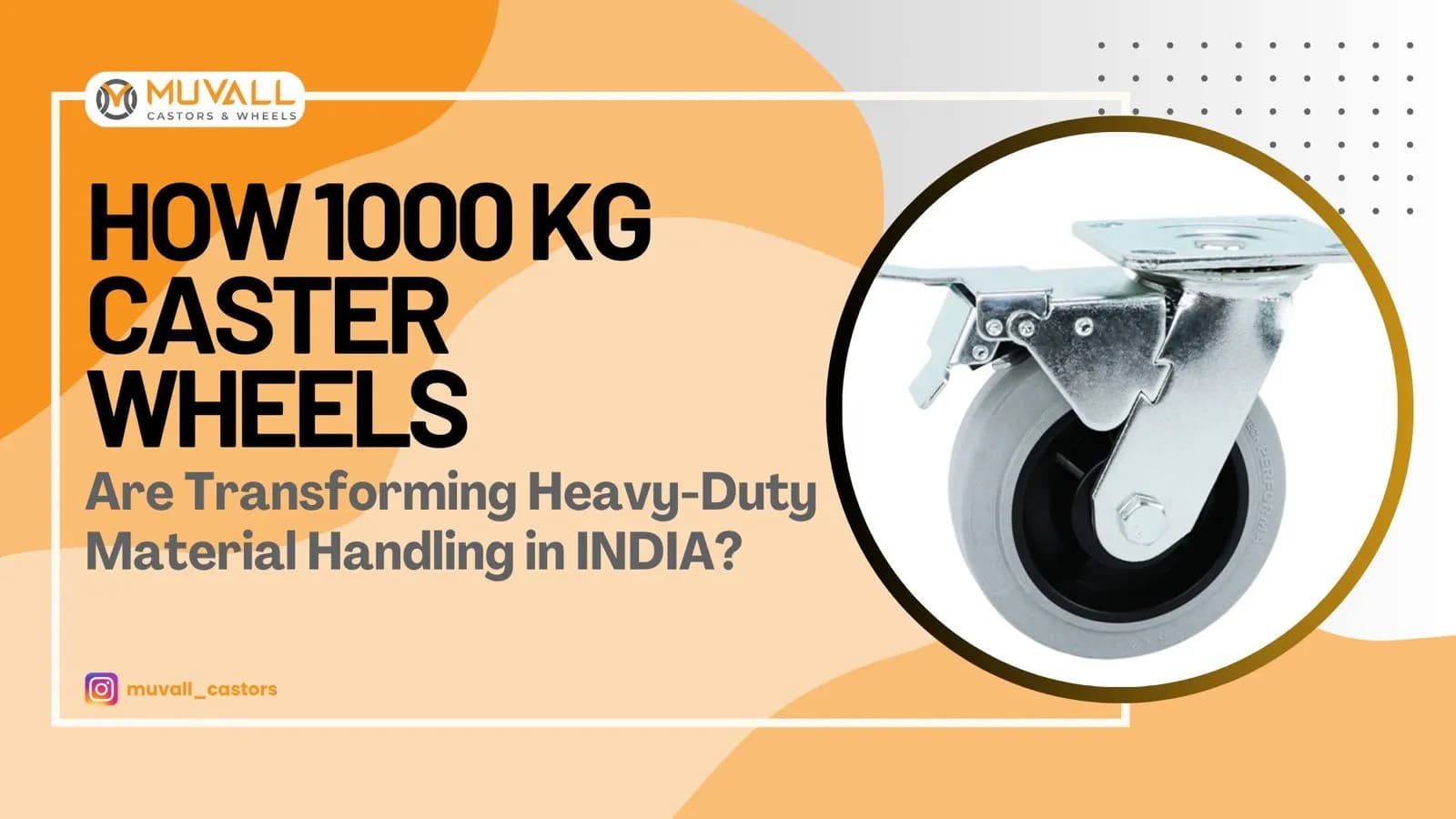
How 1000 kg Caster Wheels Are Transforming Heavy-Duty Material Handling in India
In India’s rapidly modernizing manufacturing landscape, efficiency and movement are everything. From automotive assembly lines in Pune to warehousing hubs in Bengaluru, the demand for high-load 1000 kg caster wheels is rising faster than ever. What used to require forklifts or manual cranes can now be handled by precision-engineered mobility systems using heavy-duty castors. According to recent industry estimates, India’s industrial mobility and caster wheel market is projected to grow at 10–12% CAGR through 2030, driven by logistics automation, e-commerce warehousing, and the government’s Make in India initiative. Among leading contributors to this revolution is Muvall Castors Pvt. Ltd., a Bengaluru-based ISO 9001-certified manufacturer known for its tested and certified wheel systems. 1. The Shift Toward High Load Capacity Mobility Heavy-duty equipment once relied on welded stands or mechanical lifts. Today, industries are adopting modular, wheeled solutions capable of carrying up to 1000 kg per wheel. Muvall’s forged steel and cast-iron polyurethane series are prime examples of this shift. These castors are now standard in: Automotive OEM production floors Aerospace component assembly Warehousing & logistics trolleys Heavy die handling carts By replacing static bases with dynamic mobility platforms, companies are achieving: Up to 40% reduction in material movement time 20–25% improvement in floor space utilization Safer and smoother handling with reduced operator fatigue 2. Engineering Excellence Behind 1000 kg Castor Wheels A modern 1000 kg caster wheel isn’t just a piece of metal — it’s a precision system built from multiple engineered components.Muvall’s high-load wheels feature: Component Description Wheel Material Cast Iron Core + Molded Polyurethane (85 Shore A hardness) Frame Forged or Fabricated Steel, Powder-Coated for Corrosion Resistance Bearing Type Dual Ball or Tapered Thrust Bearings for Smooth Swivel Temperature Range –10 °C to +60 °C Testing Dynamic Load, Rolling Resistance, and Endurance Tests This combination ensures not only high load tolerance but also consistent ergonomic efficiency, meaning less force is required to start and sustain movement. 3. The Real-World Impact on Indian Industries Let’s look at a few examples where Muvall 1000 kg castors are changing the game: Automotive Plants (Gujarat, Chennai): Using HDF Forged Steel PU Castors, large car body frames are now moved between welding and paint booths without cranes. Warehousing (Delhi NCR): MFTP Fabricated Steel Castors with PUCB wheels allow pallet systems to move 3-ton loads effortlessly. Foundries (Pune, Coimbatore): Super Heavy Duty HDP Castors perform under high temperature and metal dust exposure, reducing downtime. 4. Why Polyurethane Rules the Indian Market While cast iron and nylon were once the go-to materials, Polyurethane (PU) Wheels is now dominating the Indian heavy-duty segment due to its versatility: Noise reduction — perfect for indoor factory floors. Shock absorption — protects fragile loads and machinery. Floor protection — doesn’t damage epoxy or concrete surfaces. Wear resistance — proven to last 3–5 years under rated load. According to Muvall’s internal testing data, PU wheels maintain over 90% of original performance even after 50,000 roll cycles under 1000 kg load conditions. 5. Designed for India’s Diverse Conditions India’s factories and warehouses operate across varied conditions — from humid coastal environments to dust-heavy interiors. Muvall’s heavy-duty castors are built to handle: Uneven floors and outdoor use (HDP Series) Continuous operation on automated production lines (TTBP Series) Temperature fluctuations in metalworking plants (PUCB Series) This makes them a preferred choice for OEMs, logistics providers, and large-scale manufacturers nationwide. 6. The Muvall Edge: Built for Speed, Strength & Support With over 1,500 SKUs ready to ship and a 100+ dealer network across India, Muvall Castors ensures that industrial clients can access heavy-duty solutions without delays.Each wheel undergoes Dynamic Load, Endurance, and Break Tests, ensuring performance under real-world Indian conditions. Muvall’s Philosophy: “Speed, Reliability, and Transparent Service — because mobility should never be a bottleneck.” People Also Read: Heavy Duty Castor Wheels: How to Choose the Right Ones? ConclusionThe rise of 1000 kg heavy-duty caster wheels marks a transformative moment in India’s material handling ecosystem.Whether in a high-speed assembly plant or a rugged logistics hub, the right wheel doesn’t just move loads — it moves industries forward. As India’s manufacturing story accelerates into 2025, companies like Muvall Castors Pvt. Ltd. are leading the revolution — making mobility faster, safer, and smarter.
Published on Dec 12, 2025
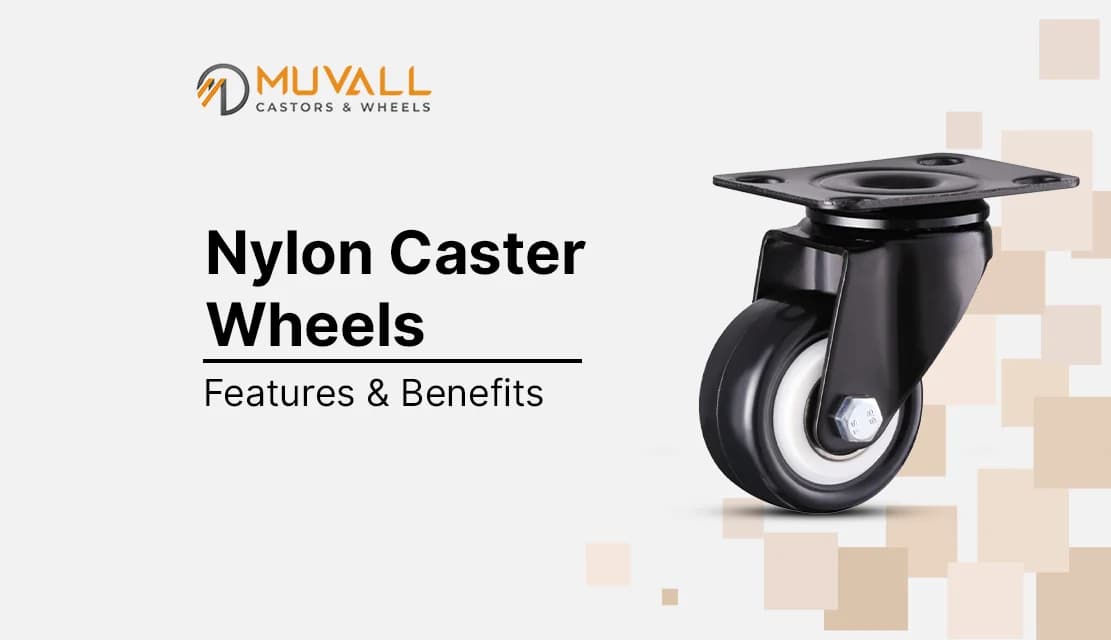
Nylon Caster Wheels By Muvall: Features And Benefits
Nylon is a strong and resilient thermoplastic. This material is used in the manufacturing of various industrial objects as it has exceptional qualities that help minimize the operating noise and reduce part weight. It is a synthetic material (man-made) that falls into the category of “Polyamides” Nylon has been used for over a century and is created by reacting Carboxylic acid molecules with Amino molecules which makes it the perfect material to be used by caster wheels manufacturers in India. Today, Nylon is used to manufacture a variety of equipment such as domestic equipment, commercial equipment, industrial equipment, caster wheels (or castor wheels) etc. Benefits Of Nylon Caster Wheels As a nylon caster wheel manufacturer, we at Muvall use nylon for its exceptional mechanical qualities and benefits, such as: High Resistance Against Friction Nylon is one of the strongest and friction resistant forms of plastic. Due to its low resistance level it offers effortless rolling capabilities which makes it easy and smooth to manoeuvre. The abrasion resistant property of nylon makes it the perfect material for manufacturing caster wheels heavy duty as it offers protection against marks or scratch damages on the floor. The low roll resistance helps reduce human effort and fatigue which is why it is a good idea to use nylon wheels for trolley manufacturing. Nylon is resistant to damages caused by a number of chemicals which makes it the ideal material for manufacturing equipment that requires regular cleaning and washing. High Tensile Strength As one of the strongest forms of synthetic plastic, nylon offers high tensile strength. This property makes it the star material of our nylon caster wheels catalogue. Nylon offers high resistance against wear and tear which makes it sturdy and protects the caster wheels from any damage on impact. It offers extraordinary capacities for carrying heavy loads as compared to other forms of plastic. High Elasticity Level Nylon features a 20% to 40% breaking extension and a 2.7 GPa modulus of elasticity. In other words, Nylon is highly elastic in nature which allows it to be moulded in any shape or form. This makes it non-brittle and allows it to remain strong even after being exposed to the sun and heat for a long period of time. It does not wear and tear with time as other materials often do and will remain unfaded and as good as new for years. Nylon 66 and Nylon 6, two of the strongest and most durable grades of nylon offer low high mechanical and impact strength at low costs. High Melting Point and Temperature Resistance As a highly temperature resistant material, nylon offers an exceptional melting point of 268.8°C. It can handle a temperature within the range of -56°C to 121°C without breaking a sweat. Being a thermoplastic material, Nylon 6 grade offers an exceptional melting point of 220ᵒC and Nylon 66 offer a melting point of 265ᵒC, which is incredible. The high temperature resistance makes Nylon great for manufacturing caster wheels heavy duty as it offers ease of operation, without weakening, in temperatures as high as 80ᵒC and as low as -30ᵒC. These mechanical qualities of Nylon make it the ideal material for manufacturing caster wheels. Nylon Caster Wheels Catalogue By Muvall At Muvall, we are a nylon caster wheel manufacturer with a comprehensive in-house testing facility. To ensure that our products are of the highest quality, we conduct a number of rigorous quality assurance tests such as testing maximum load, tire hysteresis, material analysis and much more. Our nylon caster wheels catalogue features various products such as the European Series, the medium duty casters, heavy duty casters, etc. Each series comes in 3 different variants: Fixed casters (or castors) Swivel casters (or castors) Brake casters (or castors) Each variant can be purchased in 3 different wheel dimensions and load capacities: For the 100 x 50 mm wheel dimension, the load capacity is 200 Kg For the 150 x 50 mm wheel dimension, the load capacity is 280 Kg For the 200 x 50 mm wheel dimension, the load capacity is 300 Kg As one of the reputed caster wheels manufacturers in India, Muvall employs cutting edge technologies to manufacture industrial wheels and casters of the highest quality. We have a production system with state of the art facilities such as CO2 welding systems, power presses, auto controlled hydraulic compression moulding, hydro pneumatic press, etc. We believe that in order to create the best integrated wheels, it is crucial to have complete control over all the critical production processes. Our reputation extends across borders as a reliable and leading product manufacturer. We are known to provide mobility to a variety of industries worldwide. Our services range from industries such as hospitals, automobiles, etc. Our products are the ideal solution for equipment with load requirements ranging from 20kg to an outstanding 2000kg+ per caster. Our goal is to create and develop industrial casters and wheels that not only feature the highest of quality but are also cost effective for a diverse range of applications. We believe that we can never stop learning which is why our production processes, manufacturing processes and customer service are continually being improved. With an extensive knowledge of the industry and years of seasoned experience, Muvall commits to transform your complex and painstaking tasks into mobile and seamless jobs. We aim for consistent quality and excellence which is why our products cater to millions of industries that require casters and wheels in India. With an exceptional rate of customer repeatability (over 97%), we are the best at what we do. Key Takeaways Nylon is one of the best materials to manufacture high load equipment due to the plethora of benefits it has to offer. Here are the key takeaways from the above discussion: High resistance to abrasions A low friction level Resistance to wear and tear Resistance to impact damage Very high load capacity High resistance to heat Non-marking qualities Low cost material A long life span All these qualities make nylon the ideal material for caster wheels manufacturing.
Published on Dec 4, 2025
How to Calculate Load Capacity for Industrial Caster Wheels in India
Choosing the right Industrial caster wheel starts with a reliable load calculation. Below is a clear, India-focused, step-by-step guide (with examples) based on Muvall’s 2025 technical catalog. I’ll show the formula, how to pick a safety factor for Indian factory/warehouse conditions, and other practical checks you must run before buying. 1) The basic formula (exact) Use this formula to calculate required capacity per wheel (W): W=(L1+L2)×SnW = \dfrac{(L_1 + L_2) \times S}{n}W=n(L1+L2)×S Where: L₁ = weight of the load (kg) L₂ = tare / equipment weight (kg) n = number of wheels supporting the load S = safety factor (dimensionless) — depends on speed, floor condition, and application This formula and approach are taken directly from the Muvall catalog guidance on determining load requirements. 2) How to choose the Safety Factor (S) Muvall provides recommended safety factor ranges depending on operating conditions. Use the higher end of a range when in doubt (uneven floors, frequent impacts, outdoor use, or automated lines): Manual operation, speed < 4 km/hr Even flooring: S = 1.2 – 1.5. Uneven/outdoor flooring: S = 1.5 – 2.0. Manual operation, speed 4–6 km/hr Even flooring: S = 2.2 – 2.5. Uneven/outdoor: S = 2.5 – 3.0. Automated / continuous / high-impact systems — use the higher end of the catalog ranges or consult engineering for dynamic force analysis (catalog warns to include allowances for automated systems). Tip: for typical Indian warehouse trolleys moved by hand on decent concrete, S = 1.5 is a common conservative choice. For rough factory floors or exterior yards choose S = 2.0 or higher. 3) Worked numeric examples (digit-by-digit) Example A — Warehouse trolley (typical) Load (L₁) = 1000 kg (pallet + goods) Tare (L₂) = 200 kg (trolley frame) Wheels (n) = 4 Condition: manual push, even concrete floor, speed < 4 km/hr → choose S = 1.5. Step-by-step: Sum weights: L₁ + L₂ = 1000 + 200 = 1200 kg. Multiply by safety factor: 1200 × 1.5 = 1800 kg total required capacity (with margin). Divide by wheels: 1800 ÷ 4 = 450 kg per wheel. So choose castor wheels rated ≥ 450 kg each. (If using wheels rated exactly 450 kg, keep maintenance and environment checks in mind; choosing the next standard size up is prudent.) Example B — Heavy duty cart on uneven shopfloor Load = 2000 kg, Tare = 300 kg, n = 6 wheels, floor = uneven/outdoor → pick S = 2.0. L₁ + L₂ = 2000 + 300 = 2300 kg. 2300 × 2.0 = 4600 kg. 4600 ÷ 6 = 766.67 kg per wheel → round up to ≥ 770 kg per wheel (choose nearest standard higher capacity). Use digit-by-digit arithmetic like the examples above to avoid rounding mistakes. 4) Other factors that change the calculation or final selection The numerical result (W) is only the starting point. Match W with wheel material, diameter, bearings and castor design: Wheel material vs floor — PU is best for concrete/epoxy floors; nylon wheels/PP for dry smooth floors; UHMW/phenolic for high temp or chemical exposure. Use the catalog’s wheel vs floor mapping when deciding material. Wheel diameter — larger wheels roll easier over obstacles and reduce rolling resistance (recommended for higher loads). Bearings — double ball bearings or tapered/thrust bearings reduce starting resistance and handle higher dynamic loads (super heavy duty wheels may use multiple bearings). Mounting & castor body — forged steel, fabricated steel, or pressings differ in strength; for high loads prefer forged or properly fabricated heavy-duty castors. Ergonomics & push–pull — even if per-wheel rating is OK, excessive push/pull force is a safety concern. Muvall recommends push-pull evaluation; recommended human force limits are cited in the catalog (initial/sustained force guidelines). 5) Practical selection checklist (before you buy) Calculate W exactly using the formula and pick S based on floor/speed. (See examples.) Round W up to nearest standard wheel rating available (don’t underspec). Confirm wheel material fits floor & environment (PU, PUCB, UHMW, nylon, phenolic, etc.). Check wheel diameter — larger for uneven floors. Verify bearing type on chosen castor (double ball / tapered / thrust for heavy duty). Confirm castor body (forged/fabricated) and plate/stem dimensions match your mounting. Run a push–pull test on a prototype trolley to confirm ergonomic forces are acceptable. 6) Quick reference table (common scenarios) Scenario ggested Safety Factor S Note Manual, even concrete, low speed (<4 km/hr) 1.2 – 1.5 Typical warehouses.Manual, uneven/outdoor 1.5 – 2.0 Yard, rough shop floors.Manual, faster (4–6 km/hr) 2.2 – 2.5 When carts are moved fast.Automated / high impact 2.5 – 3.0 (or higher) Perform dynamic analysis. 7) Common mistakes to avoid Using catalog static rating without safety factor — catalog ratings often assume manual use at low speed; always apply S. Ignoring floor type — a wheel chosen for epoxy might fail on metal chips or rough concrete. Undersizing bearings / castor body — wheel load capability only matters if the castor body and bearings can handle the forces. People Also Read:How the Right Number of Caster Wheels Can Ease Heavy Load Movement 8) Short example for Indian users — ready checklist to run now Measure load (L₁) and tare (L₂). Count number of wheels (n). Typical: 4 or 6. Pick S from the table above based on your floor (choose higher if unsure). Compute W = (L₁ + L₂) × S ÷ n (do the math digit-by-digit). Select wheel type (PU for indoor concrete; PUCB for heavy-duty; UHMW for corrosive). Confirm castor body, bearings, and plate/stem dimensions match equipment.
Published on Nov 24, 2025
Top 5 Heavy-Duty Caster Wheels for Industrial Use in 2025
India’s manufacturing, logistics, and warehousing sectors are scaling faster than ever, and along with this growth comes the need for stronger, safer, and more reliable industrial mobility systems. Whether you’re moving dies, molds, CNC equipment, automated platforms, or heavy assemblies, choosing the right heavy-duty castor wheel directly impacts uptime, operator safety, and productivity. With over a decade of engineering excellence, Muvall Castors Pvt. Ltd. continues to lead India’s industrial castor market through precision manufacturing, ISO 9001-certified quality processes, and superior load-engineered designs. This 2025 guide presents the Top 5 Heavy-Duty Caster Wheels, fully updated with accurate load ratings, wheel sizes, bearing configurations, and castor specifications. Muvall HDP Series – Cast PU Wheel Load Capacity : 800–1200 kg per wheel Wheel Sizes : 6×3 inch, 8×3 inch Mounting Types : Rigid / Swivel / Swivel with Brake (Wheel Brake) The HDP Series is engineered for heavy-duty industrial environments where smooth rolling and long-term durability are essential. Why it stands out Swivel head includes heavy-duty ball bearings → smooth rotation & effortless maneuvering. Cast PU wheel offers low noise, floor protection, and high cut resistance. Powder-coated body for long service life. Best suited for CNC machinery, fabrication units, trolleys, assembly lines, and general industrial movement. Muvall HDP Series – Cast Nylon Wheel Load Capacity : 800–1200 kg per wheel Wheel Sizes : 6×3 inch, 8×3 inch Mounting Types : Rigid / Swivel / Swivel with Brake (Wheel Brake) Designed for rugged industrial environments where floors may be uneven or exposed to oils, heat, or moisture. Why it stands out Extremely rigid wheel for minimal deformation under load. Highly chemical- and moisture-resistant. Smooth maneuvering due to ball bearings in the swivel head. Best suited for Foundries, heavy material transport, industrial carts, and outdoor factory applications. Muvall TTBP Series – Cast PU Wheel Load Capacity : 1600–2000 kg per wheel Wheel Sizes : 6×3 inch, 8×3 inch Bearings : 4 Double Ball Bearings in the Wheel Hub Mounting Types : Rigid / Swivel / Swivel with Brake (Single Wheel Brake) For extreme-duty mobility, the TTBP Series uses a precision Tapered + Thrust Bearing Swivel Head, enabling smooth rotation even at maximum load. Why it stands out 4-bearing hub design → reduced friction & exceptional load distribution. Tapered + thrust bearings in the swivel head → high stability under torque, vibration, and directional changes. PU wheel delivers shock absorption, thermal resistance, and low rolling effort. Best suited for Automated systems, metal fabrication lines, rapid-movement industrial equipment, high-load transfer carts. Muvall TTBP Series – Cast Nylon Wheel Load Capacity : 1600–2000 kg per wheel Wheel Sizes : 6×3 inch, 8×3 inch Bearings : 4 Double Ball Bearings in the Wheel Hub Mounting Types : Rigid / Swivel / Swivel with Brake (Single Wheel Brake) Built for operations that demand uncompromising rigidity, impact resistance, and high load endurance. Why it stands out Tapered + thrust bearings in the swivel head ensure excellent swivel under extreme weight. Zero-flex Cast Nylon guarantees stability during continuous cycles. Ideal for environments with metal chips, uneven flooring, or high-temperature variations. Best suited for Robotic conveyors, aircraft tooling, railway fixtures, heavy molds & dies. Muvall HDTW Series (NEW) – Heavy Duty Twin Wheel Series Load Capacity : 4000–5000 kg per wheel Wheel Format : 2 Wheels × 3-inch width each (Twin Wheel) Wheel Sizes : 6-inch & 8-inch Mounting Types : Rigid / Swivel / Swivel with Brake (Single Wheel Brake) Swivel Head : Precision Tapered + Thrust Bearings The latest advancement in Muvall’s heavy industry range, the HDTW Series is engineered for ultra-heavy loads where stability and safety cannot be compromised. Why it stands out Twin-wheel design doubles the contact surface, reduces wear, and improves stability. Tapered + thrust bearing swivel head → optimal rotation under extreme load. Significantly lower rolling resistance compared to single-wheel configurations. Designed for long-cycle, high-weight industrial movement. Best suited for Steel plants, aerospace jigs, heavy die-handling, gantry systems, mining equipment, large AGVs, and massive industrial platforms. Industrial Insight: India’s Heavy-Duty Mobility Market 2025 ₹1,500+ Crore industry Growing at 10%+ CAGR Top users: Warehousing (35%), Automotive (28%), OEMs (22%) Preferred material: Polyurethane (PU) for durability + floor protection Muvall PU wheel lifespan: 3–5 years under rated usage People Also Read : Heavy Duty Castor Wheels: How to Choose the Right Ones? Mounting & Brake Options Across All Series All Muvall heavy-duty series (HDP, TTBP, HDTW) are available in: Rigid Castor For straight-line, stable movement. Swivel Castor For 360° maneuverability. Swivel with Brake Ensures wheel stop-locking under high loadMaintains safety without restricting maneuverability Why Muvall Castors Lead the Industry ISO 9001-certified manufacturing 1,500+ ready SKU’s Nationwide network across 100+ cities
Published on Nov 24, 2025
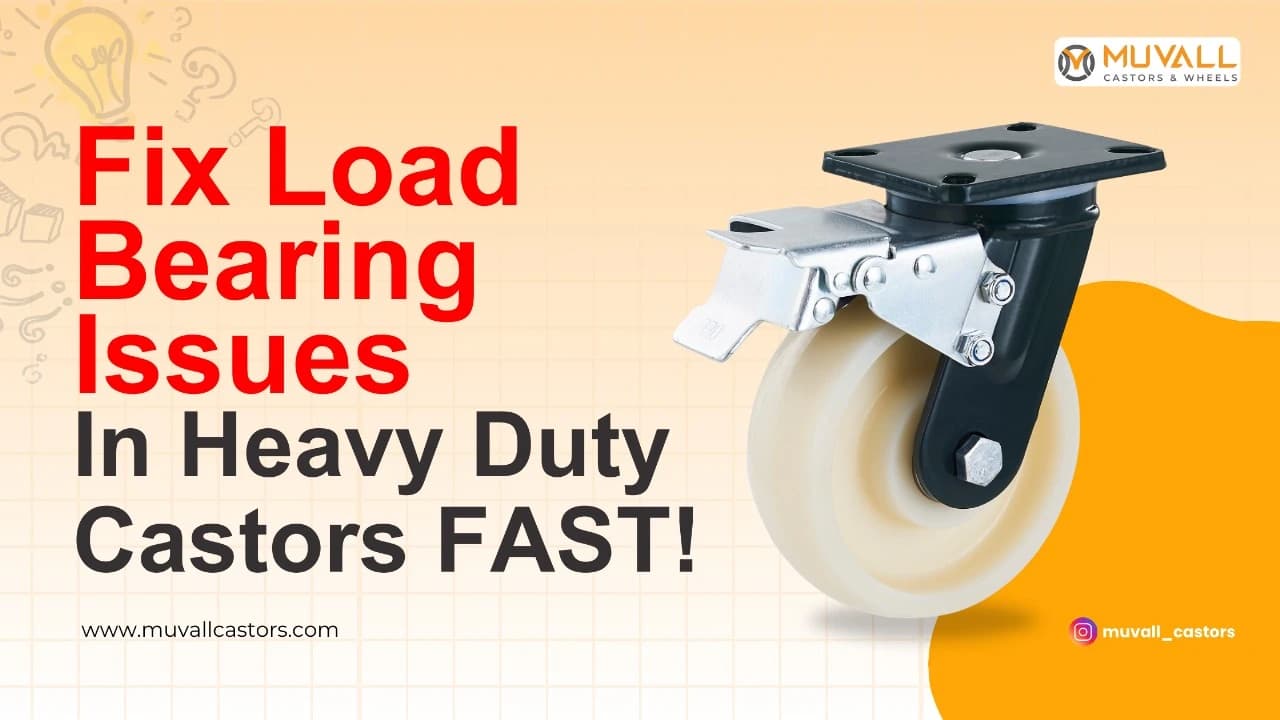
How to Identify and Fix Load-Bearing Issues in Heavy Duty Castors
IntroductionHeavy duty castors are the backbone of industries like automotive, steel, logistics, and construction in India. They are designed to handle loads from 250 kg to over 2000 kg per wheel. But even the strongest castors fail if load-bearing issues aren’t addressed. This blog explains how to identify problems early and fix them, ensuring maximum life and safety from your heavy-duty castors. Signs of Load-Bearing Issues Flattened wheels – Permanent deformation due to overload. Cracked tread – Often seen in rubber wheels under excessive load. Bent mounting plates – Caused by shock loads on uneven floors. Difficulty in swiveling – Overloaded bearings restrict movement. Uneven wear – When one wheel carries more load than others. Causes of Load-Bearing Failures Overloading beyond rated capacity. Ignoring safety factor (especially in uneven floors or outdoor use). Incorrect wheel distribution – 3-wheel vs 4-wheel setups. High-speed operations without suitable castor type. How to Fix & Prevent Issues 1. Correct Load Calculation Use Muvall’s formula:Load per wheel = (Load + Equipment Weight) ÷ No. of wheels × Safety Factor Example: A 1200 kg machine with 4 castors on uneven floors → Safety factor 2.2. Each wheel must handle 660 kg. 2. Choose the Right Heavy-Duty Castor Heavy Duty Castors (HMP): Up to 600 kg, excellent for shock loads. Extra Heavy Duty Castors (HDP): Up to 1000 kg, excellent for heavy industries. Super Heavy-Duty Tapered Bearing Castors (TTBP): For extreme industrial loads. 3. Proper Mounting Always use parallel mounting for fixed castors. For long trolleys, use 2 swivel + 2 fixed or 6-wheel dynamic shift configuration for better load distribution. 4. Maintenance for Heavy-Duty Use Lubricate bearings every 2 weeks in steel plants or foundries. Inspect for cracks in polyurethane treads due to metal chips. Replace bent brackets immediately. 5. Upgrading When Needed If failures persist: Shift from rubber to polyurethane. Use forged steel with tapered bearings for high-impact industries. Real-World Example At an Indian auto-component manufacturing plant, material handling was a recurring challenge. The facility was using nylon wheels rated for 500 kg each on heavy trolleys carrying engine blocks. Despite being within rated load, frequent breakdowns occurred—wheels would chip under shock loads, and brackets would bend during sharp turns on uneven shop floors. Muvall conducted a detailed audit and found two key issues: Load miscalculation – The plant was not factoring in uneven floor conditions and sudden dynamic loads from forklift handling. Incorrect wheel material – Nylon provided strength but lacked shock absorption and durability for continuous heavy-duty cycles. We recommended upgrading to CI-core polyurethane castors with tapered roller bearings, rated for 900 kg per wheel. The results were immediate: 35% reduction in downtime due to wheel-related failures. Improved load stability during transport of engine blocks. Lower maintenance costs, as wheels lasted significantly longer even in high-impact conditions. Lesson Learned: Even if the rated load seems sufficient, real-world conditions like uneven surfaces, shock loads, and continuous use demand stronger wheels and a higher safety factor. Also read : A Guide To Choosing the Right Industrial Trolley Wheels for Heavy Loads Outdoors ConclusionHeavy-duty castors are strong but not invincible. The key to preventing load-bearing issues lies in correct load calculation, right material selection, and regular maintenance. With Muvall’s wide range of heavy-duty castors, Indian industries can ensure reliability, safety, and smooth operations.
Published on Oct 9, 2025
Caster Wheels Safety & Care: Prevent Accidents in Indian Warehouses & Factories
Introduction Every warehouse manager in India knows that accidents can occur in seconds. A jammed trolley wheel or an overloaded cart can cause worker injuries, damaged goods, and costly downtime. The humble caster wheel, often overlooked, plays a crucial role in safety. Proper safety practices and care can prevent accidents and ensure seamless operations. Why Safety Matters in Warehouses & Factories Worker protection: A trolley with faulty castors requires extra force, leading to strain injuries. Product safety: Heavy machinery or fragile goods are at risk if wheels fail. Operational efficiency: Smooth wheels = faster movement of goods. Common Safety Hazards Overloading: Wheels used beyond rated load capacity (e.g., using a 150 kg wheel for 300 kg load). Uneven flooring: Indian factory floors often have cracks or debris, increasing the risk of tipping. Poor maintenance: Lack of cleaning & lubrication. Wrong wheel material: Using nylon wheels on oily surfaces → slipping hazard. Safety & Care Best Practices 1. Load Management Always calculate load per wheel = (total load + equipment weight) ÷ number of wheels × safety factor.Example: A 600 kg trolley with 4 wheels → Each wheel must support at least 180 kg with safety factor. Case Example: A large e-commerce warehouse was using TPU wheels with 32 mm width, rated for 130 kg per wheel. They faced frequent failures—the core was breaking, and bearings would come out, leaving trolleys unusable. After conducting an audit, we discovered that the trolleys were exposed to frequent shock loads and very high usage. Factoring in safety margins, the actual requirement was 200 kg per wheel. As per IS 22878, rated load capacity is tested on steel surfaces and does not account for shock loads or uneven weight distribution. By switching to 100×38 mm PU wheels with nylon cores, durability improved significantly, and push/pull forces reduced by 7–8%, improving ergonomics and worker safety. Takeaway: Always factor in real-world usage conditions—not just rated load—when selecting wheels. 2. Right Wheel Material Polyurethane (PU): Best for Indian concrete/epoxy floors. Elastic rubber: Shock absorption for uneven floors. Nylon: Good for smooth floors but avoid on oily surfaces. 3. Regular Maintenance Weekly checks for loosened bolts, debris entanglement, or flat spots. Monthly lubrication schedule. 4. Ergonomics & Worker Safety Recommended push force: ≤320N for men, ≤220N for women. Using tapered tread PU wheels can reduce push-pull effort by 10–15%. Also Read: 9 Signs Your Industrial Castors Are Wearing Out and How to Fix Them 5. Accident Prevention in Indian Context Mark pathways in warehouses to reduce uneven usage. Train workers to avoid overloading trolleys. Use braked castors in inclined areas. Conduct periodic wheel audits to ensure correct capacity and material selection (as shown in the case example).
Published on Sep 19, 2025
Avoid These 5 Mistakes When Buying Wheels for Your Cart Online
Introduction Buying wheels for cart online sounds simple — search, click, and order. But in reality, the process can be tricky, especially if you need them for industrial or commercial use. The wrong choice can mean higher costs, poor performance, and wasted time. Over the years, we’ve spoken to hundreds of buyers who purchased wheels for cart online, and the same mistakes keep showing up. This guide will help you avoid those pitfalls, save money, and get the right product the first time. Mistake 1: Relying Solely on Amazon for Industrial Wheels When you search for wheels for cart online, Amazon often tops the results. While it’s a convenient option with plenty of listings, it’s not always the best for serious buyers. Advantages of Amazon: Wide variety of options. Easy to compare basic specifications. Ideal for one-time or small-quantity purchases where you don’t want to spend time talking to multiple vendors. Risks and Limitations: Parameters are often generic, not tailored to industrial needs. Prices are usually higher due to platform commissions. Most sellers in India are neither manufacturers nor wholesalers. Quality variation can be huge, and brand credibility is not always clear. Pro Tip: If you are a bulk buyer or have specific requirements, Amazon should be your last resort, not your first. Mistake 2: Assuming Indiamart Will Give You the Best Deal Indiamart is a large B2B platform and a great place to discover companies that sell wheels for cart. But many buyers quickly feel overwhelmed. What Works Well: Helps identify multiple suppliers quickly. Access to companies that are active in B2B sales. Challenges: Limited product information online. You’ll get calls from too many sellers after enquiring, often without a clear way to compare them. A low-quality supplier and a reputable manufacturer may quote similar prices — making it hard to judge value. Quality and reliability are impossible to confirm from listings alone. At Muvall, we hear frequent complaints from buyers who faced “supplier fatigue” on Indiamart — too many calls, no clear way to filter, and no real hierarchy of expertise. Pro Tip: Use Indiamart for supplier discovery, but do your homework after shortlisting. Request detailed specs, check for past clients, and insist on technical data sheets. Mistake 3: Not Exploring Newer Industry-Focused PlatformsPlatforms like Industry buying are now focusing on industrial products and are starting to list sellers offering wheels for cart. Muvall Castors is also listed here to reach serious industrial buyers. The Upside: Targeted towards industrial requirements. Cleaner product categorization. The Limitation: Still early-stage — fewer sellers compared to mature platforms. Range of options is limited for certain categories. Pro Tip: Keep these platforms on your radar as they grow. They may offer better B2B-focused search experiences than Amazon or Justdial. Mistake 4: Treating Justdial as a Reliable Source for Bulk OrdersJustdial is primarily retail-focused, which means fewer genuine wholesalers or manufacturers list there. Where It Works: Finding small, local suppliers. Where It Fails: Limited presence of large-scale suppliers. Difficult to verify quality and capacity for industrial supply. Pro Tip: For large orders, skip Justdial. For small urgent needs from local vendors, it can be a quick fix. Mistake 5: Not Going Direct to Manufacturers and Wholesalers The biggest issue across all online aggregator platforms is the lack of standardization in product listings and the absence of established brands in the wheels for cart category. If you’re a bulk buyer, your best bet is often to: Search for suppliers’ direct websites — serious manufacturers and wholesalers usually maintain an updated site with detailed product catalogs. Shortlist based on product details, technical specifications, and available certifications. Reach out to 4–5 companies in parallel to maximize your chances of getting quick responses. Challenges: Some companies are slow to respond — replies may take 4–5 days, or you may not hear back at all. Pro Tip: Use Google My Business to find local vendors and check reviews. Speak to suppliers to gauge their expertise, professionalism, and response speed. If you’re short on time and need guaranteed quality and prompt service, work directly with established wholesalers and manufacturers like Muvall Castors — we focus on transparency, high product standards, and quick turnarounds. Also Read: PU Caster Wheel: Why Use It in Industrial Applications? Final Thoughts Buying wheels for cart online can save you time and money, but only if you avoid the common mistakes that trap many buyers. Start with the right platform for your needs, do your homework, and don’t be afraid to reach out directly to reputable manufacturers. If you want expert guidance in choosing the right wheels for your specific application, our team at Muvall Castors Pvt. Ltd. is here to help — ensuring you get the best balance of quality, price, and service
Published on Aug 8, 2025
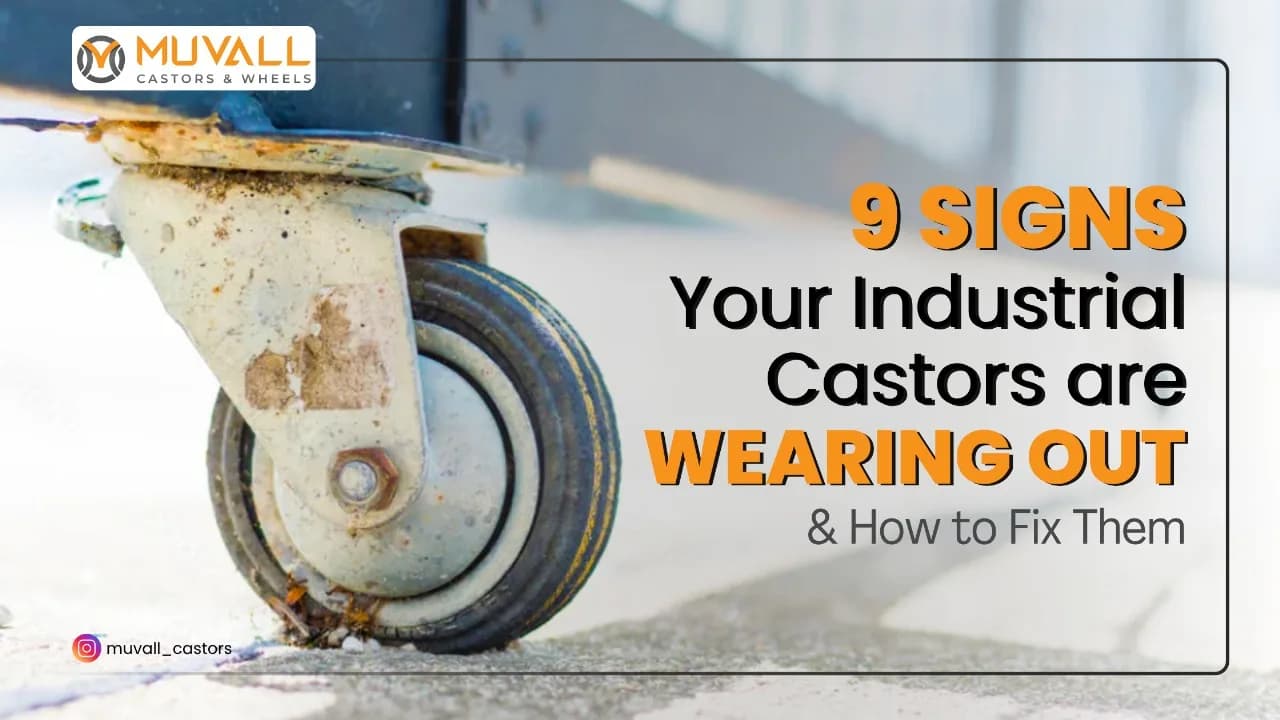
9 Signs Your Industrial Castors Are Wearing Out and How to Fix Them
Industrial castors are the unsung heroes of many workplaces — from warehouses and factories to hospitals and airports. These small but mighty wheels enable heavy machinery, trolleys, and carts to move smoothly and safely, improving efficiency and reducing worker fatigue. But like any equipment, caster wheels don’t last forever. Worn-out or damaged industrial castors can lead to increased downtime, safety risks, and costly repairs if not addressed early. That’s why it’s crucial to know the warning signs that your trolley wheels need attention — and how to fix them before problems escalate. In this blog, we’ll walk you through 9 signs your industrial castors are wearing out, plus practical tips to keep your equipment rolling smoothly. Difficulty Steering or ManeuveringIf your trolley or equipment suddenly feels harder to steer, it’s often a sign that the caster wheels are worn or jammed. Dirt, debris, or damage to the swivel mechanism can reduce mobility. How to Fix: Check for threads or other debris stuck in the fork where the wheels are assembled with the castor and remove it. Clean the wheels and swivel joints regularly to remove debris. Lubricate swivel bearings with a suitable grease. 2. Uneven or Worn Wheel Treads Uneven wear on the wheel tread affects smooth rolling and can damage floors. It also puts extra strain on the castor assembly. How to Fix: Inspect the wheel tread regularly. Replace wheels with uneven or bald treads immediately. Choose durable wheel materials (e.g., nylon for rough surfaces). 3. Excessive Noise During Movement Loud squeaks or grinding noises signal problems with the industrial castors. This could be due to worn bearings, lack of lubrication, or damaged wheels. How to Fix: Apply lubricant to the wheel bearings and swivel joints. Replace bearings or entire wheels if noise persists. Ensure the wheels are suitable for your floor type to reduce noise. 4. Visible Cracks or Breaks in the Wheel Cracks, chips, or broken parts on the wheels compromise load capacity and safety. How to Fix: Inspect wheels for visible damage regularly. Replace any damaged wheels promptly — never try to repair cracks. Use wheels made of materials suitable for your load and environment. 5. Castors Not Locking Properly Many trolley wheels come with locking mechanisms to keep equipment stationary. If locks don’t hold, it can lead to dangerous movement. How to Fix: Check the locking mechanism for dirt or damage. Clean and lubricate the lock parts. Replace the locking castor if it fails to hold after cleaning. 6. Uneven Equipment Height or Wobbling Wobbling or uneven height suggests that one or more castors are damaged or worn unevenly. How to Fix: Check all wheels for consistent size and condition. Replace mismatched or worn wheels. Make sure all wheels are rated for the equipment’s load. 7. Difficulty in Rolling Over Floor Obstacles If the trolley wheels struggle to roll over small obstacles like cracks or bumps, it can be due to worn wheels or inappropriate wheel size. How to Fix: Choose larger diameter wheels for rough or uneven floors. Replace worn wheels with new ones designed for your floor conditions. Consider soft tread materials for sensitive floors. 8. Corrosion or Rust on Metal Parts Corrosion weakens the castor’s structural integrity, especially in humid or chemical-exposed environments. How to Fix: Inspect metal parts regularly for rust. Clean and apply anti-rust coatings if corrosion is minor. Replace severely corroded castors. Opt for stainless steel or corrosion-resistant materials if needed. 9. Increased Effort Required to Move Loads If your workers report needing more force to push or pull trolleys, the industrial castors may be failing. How to Fix: Inspect wheels and swivel joints for wear or damage. Lubricate moving parts regularly. Replace worn wheels or bearings to restore smooth motion. Also Read: How Castor Wheels Revolutionize Material Handling in Various Industries Final Tips for Maintaining Your Industrial Castors Proper maintenance can extend the life of your caster wheels and save on downtime: Schedule Regular Inspections: Check wheels, bearings, and locks monthly. Keep Wheels Clean: Remove debris and dirt that can cause wear. Lubricate Moving Parts: Use the right lubricants for bearings and swivels. Use the Right Wheels: Match wheels to your floor type and load requirements. Replace in Time: Don’t wait for castors to fail completely — replace worn parts early. Why Quality Industrial Castors Matter Investing in high-quality industrial castors and trolley wheels pays off in the long run with safer, smoother operations and fewer repairs. At Muvall Castors, we offer a wide range of durable, reliable castor wheels designed to fit various industries and applications. If you suspect your castors need attention or want to upgrade your equipment, contact us today for expert advice and solutions!
Published on Jul 31, 2025
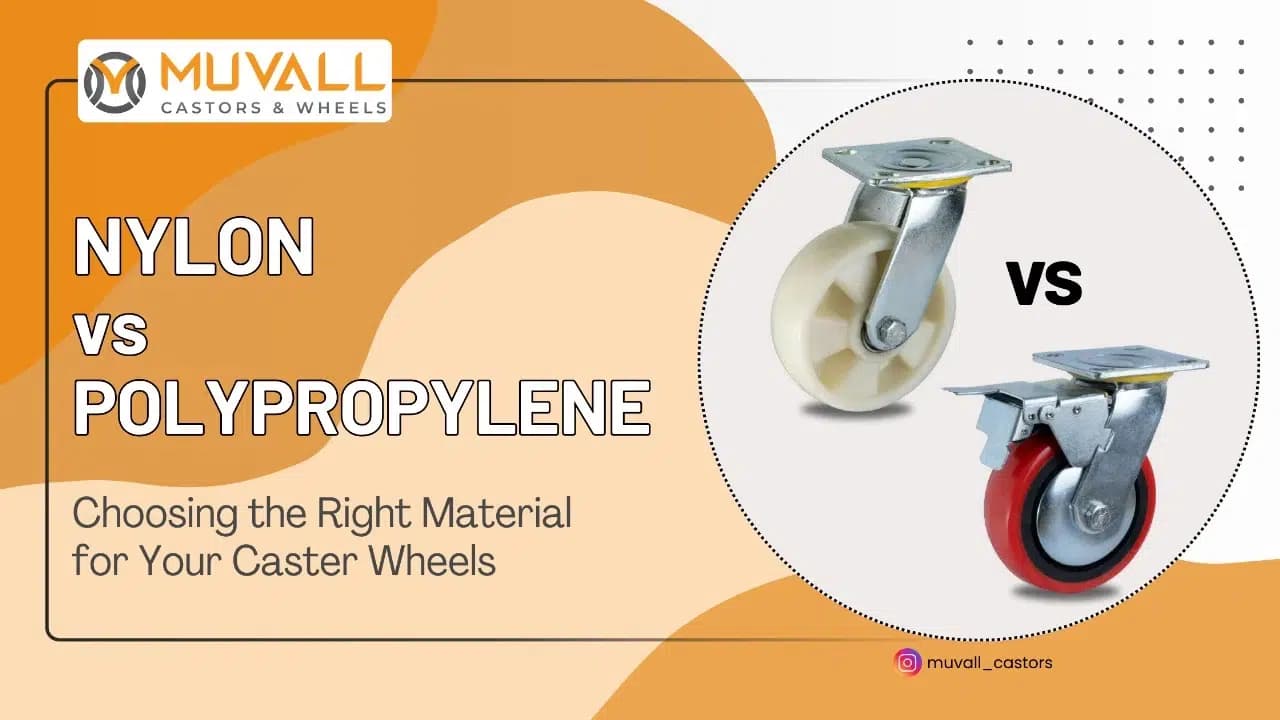
Nylon wheels vs. Polypropylene wheels: Choosing the Right Material for Your Caster Wheels
Caster wheels may look like a small part of your trolley or equipment, but trust us—they carry the entire load (literally). Now, when it comes to selecting the right material, the most common debate is: nylon wheels vs. polypropylene wheels. What’s the difference? Does it really matter? And why do so many people mix them up? Let’s break it down in simple terms so your decision rolls smoothly—just like your wheels should. First, Let’s Understand the Basics What is Nylon?Nylon is like the strong, silent type. It’s a high-strength synthetic polymer known for its toughness, wear resistance, and ability to carry heavy loads. Commonly used in heavy-duty caster wheels, nylon wheels are made for the big leagues—think factory floors, warehouses, and all things industrial. Key Features of Nylon Wheels: High load-bearing strength Excellent resistance to abrasion Handles heat and impact like a champ Low rolling resistance (easy to move) Doesn’t mind rough terrain What is Polypropylene? Polypropylene, or PP (not to be confused with your friend who cancels plans), is lightweight, budget-friendly, and offers great chemical resistance. It’s the go-to for light to medium-duty caster wheels—ideal for clean indoor spaces where weight and noise matter more than brute strength. Key Features of Polypropylene Wheels: Lightweight and cost-effective Excellent resistance to water and chemicals Quieter and smoother on delicate floors Ideal for trolleys that aren’t carrying a mini elephant Can deform under high load or heat Nylon vs Polypropylene: The Quick Comparison Feature Nylon Caster Wheels Polypropylene Caster Wheels Strength High (great for heavy-duty loads) Medium (light to moderate loads) Durability Very durable Less durable under harsh conditions Weight Heavier Lighter Chemical Resistance Good Excellent Noise Level Can be noisy Quieter operation Cost Slightly more expensive Very economical Temperature Handling Handles higher temperatures Limited tolerance Floor Protection May scratch delicate floors Gentler on surfaces Watch Out – Common Market Confusion Here’s something not many people tell you: In the Indian market, nylon and polypropylene are often confused—or even sold interchangeably. We’ve seen it too often. A customer asks for nylon wheels and walks away with polypropylene ones, thinking it’s all the same. Spoiler alert: It’s not. Using the wrong material can lead to: Cracks under heavy load Faster wear and tear Equipment damage Unplanned expenses (and a lot of head-scratching) Quick Way to Identify the Right Wheel: The Submersion Test Here’s a simple trick to avoid getting fooled : Drop the wheel in water. Nylon sinks (higher density than water). Polypropylene floats (lower density). Pro tip: Don’t try this at your dining table. Use a bucket. Also, ask for technical data. A good supplier will always have specs handy. At Muvall, we label our wheels clearly—so you get what you pay for. When Should You Choose Nylon Wheels? Go for nylon caster wheels if: You’re moving heavy-duty loads regularly Your trolley needs to survive impact, heat, or rough surfaces Your environment includes uneven factory floors or outdoor yards You want longevity and strength over cost Perfect For: Warehouses Manufacturing units Construction material transport Steel, metal, and automotive workshops Just a heads-up: They can be noisy on concrete floors. Use floor protection if needed. When Should You Choose Polypropylene Wheels? Choose polypropylene caster wheels if: You’re handling light to medium loads You’re working in labs, hospitals, cleanrooms, or anywhere hygiene matters You want something quiet, smooth, and gentle on the floor Your budget is tighter than your trolley turns Perfect For: Medical and hospital carts Retail store trolleys Laboratories Food-processing setups Office and institutional use But don’t overwork them—polypropylene wheels don’t love heat or heavy lifting. Caster Wheel Material: It’s a Small Choice with a Big Impact Think of it this way: choosing the wrong wheel material is like wearing flip-flops for a trek. Sure, it’s cheap and comfy… until it breaks halfway through. Nylon gives you strength, durability, and performance for demanding tasks. Polypropylene offers value, chemical resistance, and smooth movement for lighter needs. Choose smart, not just cheap. Still confused? We’ve got your back. Our team at Muvall will help you match your application with the right wheel material so your operations run smooth—no squeaks, no surprises. Also Read: Nylon vs Polyurethane Wheels: Key Differences and Choosing the Right One Conclusion So, which one should you pick—nylon wheels or polypropylene wheels? Here’s a quick cheat sheet: Heavy loads, tough environments = Go for Nylon Budget-friendly, chemical resistance, quiet use = Choose Polypropylene Don’t guess or go by looks—verify with a submersion test or supplier’s datasheet Make the right choice and your caster wheels will keep rolling strong for years.
Published on Jul 31, 2025
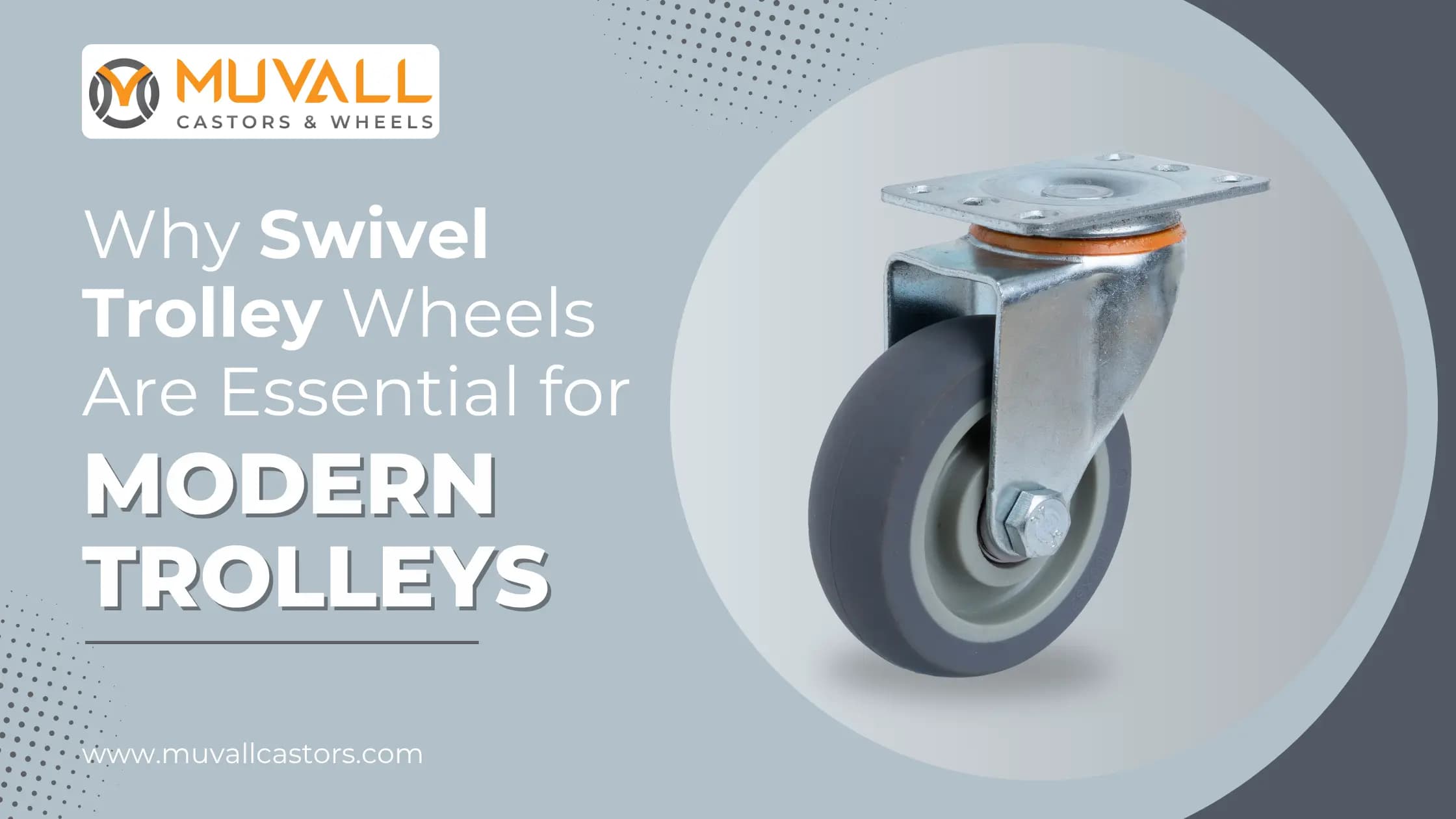
Why Swivel Trolley Wheels Are Essential for Modern Trolleys
Trolleys are used everywhere in India — from shopping malls and hospitals to factories and warehouses. But what makes a trolley truly easy to move? The answer is swivel trolley wheels. In this article, we’ll explain what swivel trolley wheels are, how they work, and why they are essential for modern-day applications. Whether you’re running a business or buying a trolley for home use, this guide will help you understand why choosing the right trolley wheels matters. What Are Swivel Trolley Wheels? Swivel trolley wheels are wheels that can rotate 360 degrees, allowing the trolley to move in any direction without lifting or turning the entire unit. They are mounted on a swivel bracket, also called a swivel plate, which enables smooth movement in tight spaces. In simple terms, swivel wheels make your trolley turn easily—like how a shopping cart moves in a supermarket. Components of a Swivel Castor To understand how swivel wheels work, it helps to know what they’re made of. Here are the key components: Fork (Yoke): Holds the wheel and connects to the top plate. Top Plate: The mounting plate that attaches to the trolley. Swivel Ball Races: Circular ball bearing raceways that enable 360-degree rotation of the fork. Tapered & Thrust Bearings (usually included in heavy-duty castors like our TTBP series): These specialized bearings in the swivel section help handle both radial and axial loads. They ensure smooth swiveling, even under heavy weights, which is essential for industrial applications. Dust Ring (standard in most Muvall castors): Prevents dust and debris from entering the swivel head, improving long-term performance and reducing wear. Axle & Bearing: Allow the wheel to rotate freely. Brake Mechanism (optional): Locks the wheel or swivel head in place to prevent unintended movement. These components are carefully engineered to work together and provide long-lasting performance, smoother handling, and greater safety—even in demanding environments. Feature Fixed Wheels Swivel Wheels Movement Direction Forward/backward only Full 360-degree rotationTurning Difficult in tight areas Smooth and flexible turningUse Case Straight, guided paths Crowded or tight spacesIdeal For Conveyor systems, rails Trolleys, hospital beds, carts Most modern trolleys combine two fixed and two swivel wheels to achieve a balance of control and maneuverability. What Is Swivel Offset — and Why It Matters Swivel offset is the distance between the vertical centerline of the top plate and the center of the wheel. This offset plays a major role in how easily the castor turns and how well it handles loads. A larger offset allows for easier swiveling but can make the wheel more prone to wobbling under load. A smaller offset improves stability but requires more effort to turn. The ideal offset strikes a balance between ease of movement and load-bearing performance. At Muvall, we carefully engineer our swivel castors with an optimized offset to reduce wobbling and ensure reliable, stable movement under load. Why Swivel Wheels Are Essential Swivel wheels offer several advantages that make them indispensable for both light-duty and heavy-duty applications. Easy to Move in Tight SpacesIn many Indian environments—shops, warehouses, kirana stores—space is limited. Swivel wheels allow trolleys to turn smoothly even in confined areas, eliminating the need to lift or reposition the trolley. Reduces Manual EffortFixed wheels require you to push and drag the trolley to turn it, which can be tiring. Swivel wheels let the trolley follow your direction with minimal resistance, reducing physical strain on workers, staff, or even elderly users. Improves SafetyBecause swivel wheels allow for better control and sharper turns, there’s less risk of bumping into people, shelves, or walls. This is especially useful in hospitals, hotels, airports, and crowded commercial spaces. Supports Heavy LoadsWhen equipped with high-quality materials like PU or nylon, and engineered components such as thrust bearings, swivel wheels can handle heavy industrial loads while still maintaining smooth movement. Increases ProductivityIn fast-paced settings like warehouses, restaurants, or delivery hubs, swivel castors speed up movement and handling, helping staff move goods more efficiently. Less effort, fewer accidents, faster workflows. Where Swivel Trolley Wheels Are Commonly Used in India Industry Common Applications Retail Shopping carts, display racks, garment railsHospitality Luggage trolleys, room service and housekeeping cartsHealthcare Hospital beds, diagnostic and medicine trolleysManufacturing Material handling trolleys, tool cartsHome & Office Utility carts, tool trolleys, filing cabinets Maintenance Tips for Swivel Castors Even though swivel wheels are built for durability, a little maintenance can extend their life significantly: Apply grease to the swivel bearing section every few months. This ensures smooth turning, especially under load. Clean out debris and dirt from the fork and wheel to prevent jamming. Check and tighten mounting bolts periodically. Choose castors with a dust ring (like most Muvall models) for lower maintenance in dusty environments. Avoid exceeding the wheel’s rated load capacity to prevent damage. What to Look for When Buying Swivel Trolley Wheels When selecting swivel wheels, consider the following: Material: PU (polyurethane), rubber, or nylon depending on floor surface and usage conditions Load Capacity: Based on the total weight of the trolley and expected load Brake Option: A locking brake improves safety, especially on inclined surfaces Wheel Size: Larger wheels (4″ or 6″) handle rough surfaces better; smaller wheels (3″) work well for indoor use Mounting Type: Choose from top plate or bolt-type mounting as per your trolley design Swivel Offset: Look for an ideal offset that balances stability and maneuverability Pro tip: For rough or uneven surfaces, use bigger wheels made of softer materials like rubber or PU to absorb vibration and provide a smoother ride. Also Read: Why Caster Wheel Size and Material Matter’s for Ergonomics Final Thoughts Swivel trolley wheels may seem like a small component, but they make a big difference in how smoothly, safely, and efficiently your trolley performs. Whether it’s about moving around tight corners, supporting heavy loads, or making work easier and safer for your team—swivel castors are a must-have for modern trolleys. So next time you’re buying or upgrading a trolley, don’t just focus on the frame or design. Look at the wheels—especially if they swivel—and make an informed decision that pays off in daily use. Frequently Asked Questions (FAQ’s) Q: Can I replace fixed wheels with swivel wheels?Yes, if the mounting type and size match, upgrading to swivel wheels will improve mobility and ease of use. Q: Which is better: rubber or PU swivel wheels?PU Wheel is more durable and ideal for smooth floors. Rubber is quieter and works better on rough or uneven surfaces. Q: Are swivel wheels safe for heavy loads?Absolutely. Just make sure to choose heavy-duty swivel castors—such as those with tapered and thrust bearings—and check the rated load capacity.
Published on Jul 10, 2025
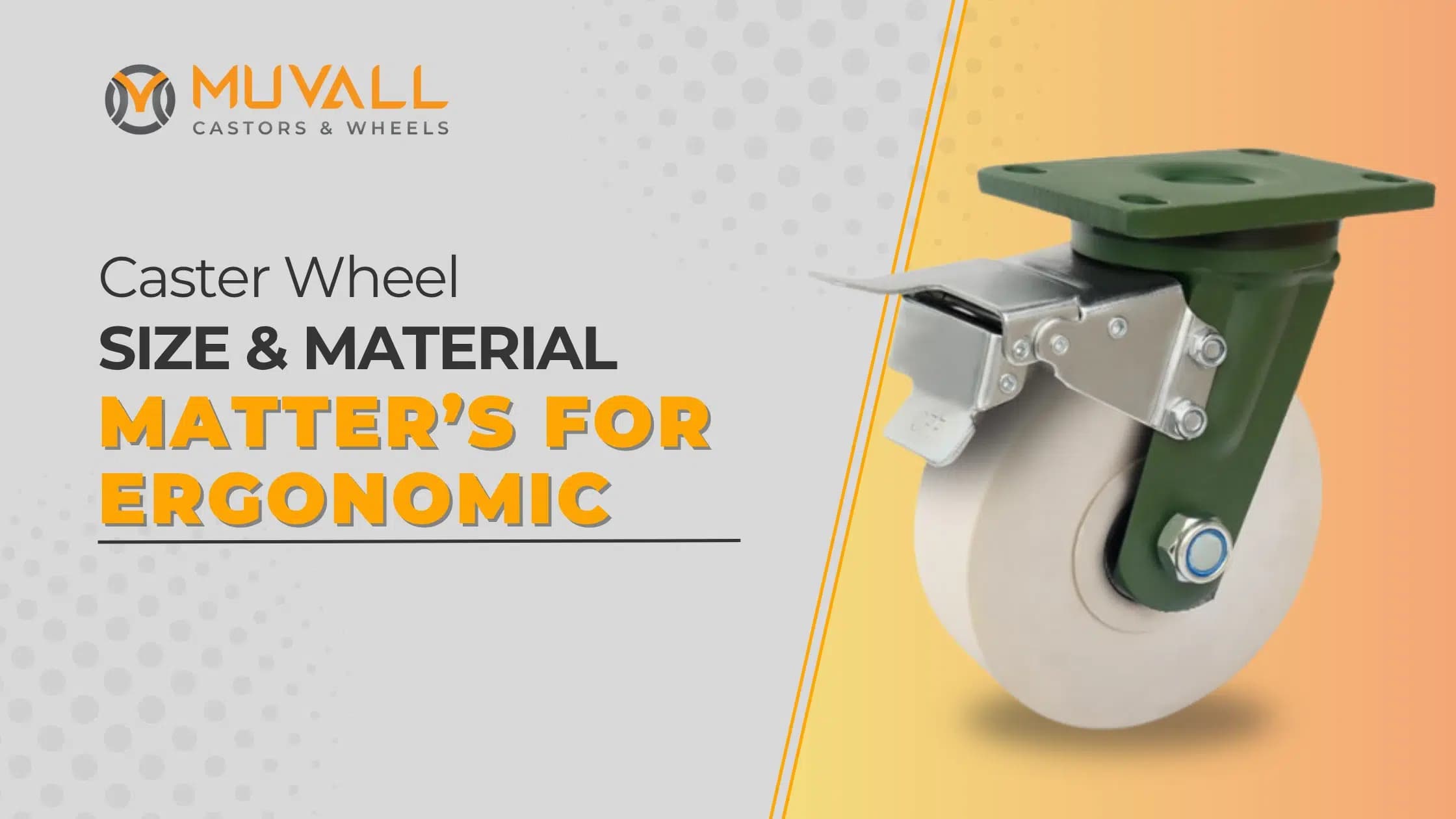
Why Caster Wheel Size and Material Matter’s for Ergonomics
The caster wheel —an invention that dates back to the late 19th century—has undergone many technical improvements over the years. Despite advancements in materials, bearings, and mounting designs, the fundamental role of the castor wheel remains unchanged: to make moving heavy equipment easier, faster, and safer. When it comes to designing efficient and ergonomic carts, trolleys, and equipment for industrial or commercial use, one factor often overlooked is wheel size and material. In this guide, we’ll explore how the size of a caster wheel, the material it’s made from, and other technical elements affect push/pull force, rolling resistance, and overall user ergonomics. The Ergonomic Advantages of a Larger Wheel If you’ve ever tried to push a cart with small hard wheels over a cracked floor, you know how difficult it can be. That’s because the diameter of a castor wheel plays a major role in determining how much effort it takes to get the load moving. Here’s how a larger wheel can improve ergonomics: Lower Rolling ResistanceA larger caster wheel creates a gentler contact angle with the floor, which reduces the effort needed to start rolling. This is especially helpful on slightly uneven or longer travel paths. Easier Obstacle NavigationLarger wheels roll over thresholds, debris, cracks, and bumps more smoothly. Think of how a bicycle with large tires handles better over uneven terrain compared to a small-wheeled scooter. Better Load DistributionA larger wheel distributes the weight of the cart or trolley across a broader footprint. This helps reduce pressure on a single point, lowering the risk of wheel lock-up or floor damage. Enhanced DurabilityLarger industrial caster wheels often allow for deeper treads and thicker materials, which improves long-term durability in demanding environments. But Bigger Isn’t Always Better If size were the only factor in ergonomics, we’d all be using 8-inch wheels. But in reality, there are trade-offs to increasing caster wheel diameter: Cost increases significantly with size, as larger wheels use more raw material. To maintain stability, increasing the diameter often means increasing the width—which further adds weight and cost. Space limitations in your equipment may not allow larger wheels. That’s why optimizing—not maximizing—your castor wheel size is key. Material Matters: What the Wheel is Made Of Another major factor affecting ergonomic performance is the material of the caster wheel. Harder Wheels Roll Easier Harder wheels (like nylon or hard polyolefin) have a lower coefficient of friction than softer materials. This means they roll more easily, especially on smooth surfaces like tile or polished concrete. For example: Nylon caster wheels are ideal for industrial use where push efficiency is a top priority. Polyurethane (PU) wheels with a Shore A hardness of 90+ strike a balance between floor protection and rolling ease. TPR (thermoplastic rubber) offers excellent floor protection but requires more effort to move. When Non-Marking Is a Must In hospitals, retail, or cleanroom environments, non-marking wheels are essential. In such cases, polyurethane caster wheels provide a great compromise between ergonomic performance and floor safety. Bearings: The Unsung Hero of Easy Movement Even with the right size and material, a castor wheel is only as smooth as the bearing it uses. Bearings reduce internal resistance and allow for smooth, consistent motion under load. Best-in-class options include: Precision ball bearings: Ideal for swivel caster wheels, they reduce torque and improve handling. Sealed bearings: Protect against dust and dirt, reducing maintenance needs. Roller bearings: Handle high-load applications with excellent strength. Without quality bearings, even the best industrial caster wheel can feel jerky and require excess force. Floor Surface and Wheel Width: Getting the Balance Right Floor Surface Not all floors are created equal. On smooth epoxy or tile floors, resistance is naturally lower. On rough concrete or pitted surfaces, even a larger wheel may face increased resistance. Choose wheel material and diameter based on your real-world conditions. Wheel Width Wider wheels improve stability, especially on uneven surfaces. But they also increase surface contact, which leads to higher rolling resistance. Narrow wheels are better for smooth, indoor surfaces where minimizing push/pull force is the goal. Also Read: How to Select Casters Based on Weight Capacity and Performance Final Thoughts: Small Changes, Big Results A properly chosen caster wheel doesn’t just protect your floor—it protects your people. By reducing the physical effort required to move equipment, you improve safety, reduce injury risks, and enhance productivity. If you’re outfitting carts or machinery for high-frequency movement, it pays to invest in the right combination of larger wheels, harder materials, and precision components. At Muvall, we offer on-site Push/Pull force testing to help you make data-driven decisions. By measuring the actual effort required with your current castor wheels versus our recommended alternatives, we provide clear, quantifiable insights—especially valuable when you’re considering replacing a large volume of caster wheels.
Published on Jul 7, 2025
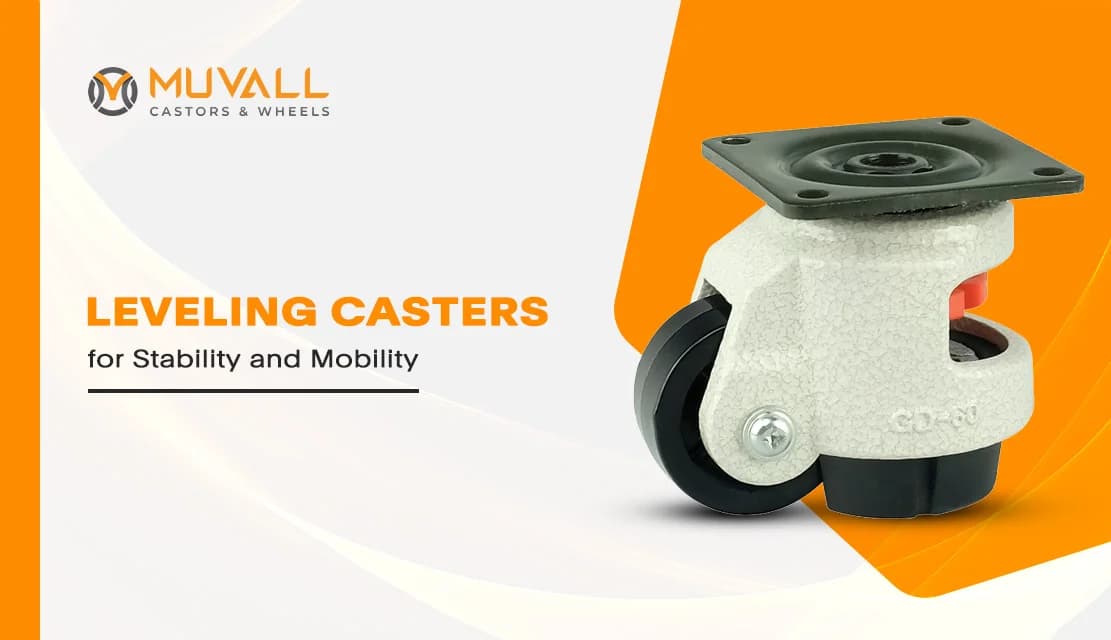
Understanding Leveling Casters: A Dual Solution for Movement and Stability
Casters come in various types, but they all have one or more wheels. These wheels are attached to the bottom of objects, which allows them to roll. Casters have changed the way we move heavy objects by making it easier to transport them with less effort. Some casters have just one wheel, while others can have two or three wheels. No matter the design, every caster has at least one wheel. Some casters also come with a special leveling feature. These are called leveling casters, and they provide a flexible option compared to regular casters. Leveling caster wheels are designed to not only move equipment but also keep it steady and stable, even on uneven surfaces. In this blog, we will discuss these casters in detail so you know how leveling casters work and where they can be used in real life. So, let us dive right in! An introduction to caster wheels Caster wheels have been widely used across various industries for centuries, with their origins tracing ancient times. These simple devices have improved over the years, with new versions such as leveling caster wheels being introduced. Leveling wheels serve a dual purpose: they allow you to move objects and also provide a means to level them. All casters support rolling, but only leveling casters support leveling. These special adjustable caster wheels have a leveling feature that enables them to transition between moving and staying in place. It makes them perfect for many different uses. Leveling caster wheels are essentially plate-style wheels that come with an integrated leveling foot. When the foot is adjusted downward, it lifts the wheel just enough to elevate the equipment slightly off the surface. This makes the equipment stay still. This clever design combines a rolling component for ease of movement with a leveling foot to ensure steadiness. The materials selected for these adjustable casters are chosen for their strength and long-lasting performance. For example, the wheel might be crafted from nylon, which can carry heavy loads and resist wear. The top plate and leveling foot are usually constructed from steel because of its durability and strength. Understanding how each part works and the materials chosen helps to appreciate the smart design of leveling caster wheels. How do leveling caster wheels work? The way a leveling caster wheel works may seem complicated, but it is actually pretty simple once you break it down. When you look at a leveling caster, you will usually see a horizontal dial positioned above the wheel. While there are various leveling caster wheel types, most have this dial. By rotating the dial, you can adjust the caster’s height. Turning it in one direction raises the caster while turning it in the opposite direction lowers it. If there are multiple leveling casters on an object, each one can be adjusted to ensure the object is level. While leveling casters still include at least one wheel, they also have a leveling mechanism, typically with a pad. By adjusting the caster’s height, the pad is pressed down onto the ground or floor, providing stability. In other words, the wheel enables the equipment to be easily moved, while the leveling foot provides stability when needed. The mechanism linking the leveling pad and the wheel allows the caster to perform both functions. By activating the leveling system, typically with a foot lever or pedal, the leveling pad is pressed down to make contact with the surface. This raises the wheel slightly above the surface, which stops the equipment from moving. When the mechanism is turned off, the leveling pad rises, and the wheel goes back down. It allows the equipment to be moved again. This clever design is what makes leveling casters different from standard ones. It is helpful to look at the simple principles behind their function to truly understand how they work. So, quickly jump to the next section! What is the technology behind leveling casters? Leveling caster wheels rely on basic physics principles like force, gravity and friction. As the equipment moves, the applied force enables the wheel to roll. It overcomes the resistance between the surface and the wheel. This is why materials such as nylon, known for their low friction, are frequently selected for the wheels. When the leveling system is engaged, the pressure applied to the leveling foot forms a solid foundation for the equipment. The combination of friction between the surface and the foot, along with the equipment’s weight (due to gravity), keeps it stationary. This is why materials such as steel, known for their strength and durability, are chosen for the leveling foot. By grasping these concepts, you can better appreciate how leveling caster wheels combine stability and movement in a simple design. The real measure of these wheels, though, is how they perform in everyday use, which we will discuss in the next section! What are the practical uses of leveling caster wheels? Many industries like manufacturing and healthcare use leveling caster wheels. In factories, they help move heavy machinery while ensuring stability during use. In hospitals, they are found on equipment like surgical carts for smooth mobility and reliable positioning. These casters improve efficiency, flexibility and safety in various settings. This makes them valuable for many applications. Why choose leveling casters? Leveling casters let you move and stabilize objects. If an item is not in level, leveling casters are a great choice. Unlike regular casters that only let you move an object, leveling casters enable both movement and adjustment for leveling. One of the key advantages of leveling casters is that they remove the requirement for separate leveling feet. Adjustable leveling feet are pads designed to stabilize and level objects, but leveling casters do the same thing. Once you install these adjustable castor wheels on an object, you will not require an extra leveling foot. Another benefit is that leveling casters prevent objects from rolling away. Simply put, when you use these casters to level an object, it remains stationary. The wheels lift off the ground and the pads press down to make the object stationary. Therefore, you can use leveling casters to keep items from moving after you have positioned them. Also Read: How to Select Casters Based on Weight Capacity and Performance Leveling caster wheels showcase the clever use of engineering principles and scientific concepts to solve practical problems. These casters change how we transport objects and set up equipment in many industries by combining the ability to move and stay stable in one simple design. Understanding how they work will help you use them effectively and see their worth for your specific requirements.
Published on Apr 30, 2025
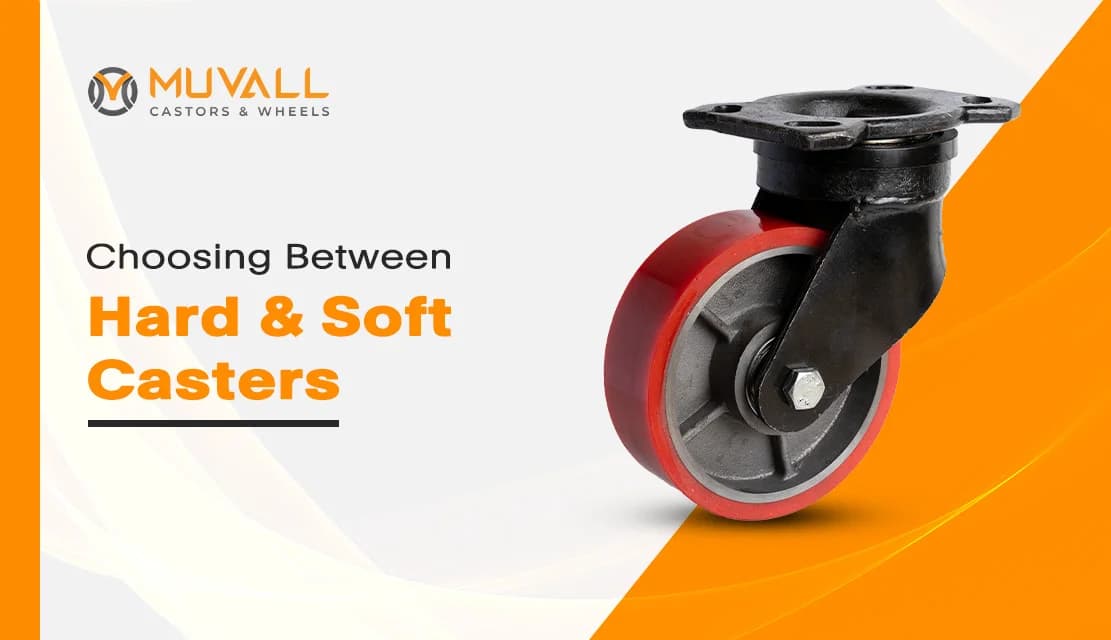
Understanding Hard and Soft Casters: Finding the Perfect Wheel for Your Needs
Caster wheels come in many different shapes, sizes and materials, which can make it tricky to choose the right one for your needs. They are generally divided into two main types: Hard tread casters and soft tread casters. Each type has its own advantages and challenges. One common challenge in the caster industry is deciding whether to use hard or soft caster wheels. The material of the wheel plays a big role in how it performs. Therefore, it is important to choose the right one for your needs. In this blog, we will discuss the main differences between hard and soft caster wheels to help you pick the best caster wheel for your application. So, let us begin! Soft vs hard casters To understand the difference between hard and soft wheels, we need to look at how each type interacts with different floor surfaces. Imagine a perfect world where all floors are smooth, clean and firm. In this case, hard wheels work best because they do not cause much resistance as they roll. However, in the real world, floors like linoleum or carpet are often softer and can get compressed under a heavy load. When this happens, the resistance the wheel faces increases and makes it harder to roll. That is why the choice between hard or soft wheels depends on the type of floor you are using them on. Soft tread casters Soft wheels come in various types that are suitable for a wide range of light to heavy commercial and industrial tasks. While they do not offer the same high-temperature resistance or traction as heavier wheels, they make up for it with their versatility, low profile and ability to handle storage and transfer tasks in unique industrial settings. Most soft casters are made from composite plastic or rubber, often with a micro-weave pattern for better traction. Though softer than hard wheels, they work well in indoor environments, typically handling temperatures between -10°C and 60°C, and are less likely to scratch or damage surfaces. The lighter weight of soft casters makes them less noticeable. Their cushioned wheels are quiet and provide a smooth ride while in motion. The main advantage of soft tread casters is their ability to reduce noise and absorb vibrations. While hard wheels are great for carpeted floors, soft wheels work better on hard floors. If you decide to use soft wheels on the carpet, do not forget to use floor mats, or you may struggle to move the wheels over the carpet. Soft wheels are similar to car tires because they can become flat and take on a new shape over time. They often return to their original form, but many times are replaced before that happens. Here are some soft caster wheels benefits: Cause less damage to the floor Provide a smoother and more cushioned ride Work well with both heavy and light loads Soft wheels are also available in special versions, such as electrostatic-proof, thermoplastic flexible types and pneumatic. It makes them ideal for sensitive and ultra-clean environments like food factories, electronic labs and hospital wards, where protecting delicate equipment and minimizing damage is important. Elastic rubber and polyurethane-coated models can handle heavy loads. However, other common soft wheels, such as pure rubber, PVC and pneumatic, may not be strong enough for heavy-duty tasks. Therefore, always check the weight ratings with your caster wheel manufacturer or supplier before purchasing. Hard tread casters Hard tread casters are made from materials like nylon, metal, phenolic and polypropylene. They are built for continuous use in both hot and cold environments and for tough jobs like kitchen racks, short-distance transportation and warehouse crates. Hard wheels are reliable and tough, no matter the conditions. Nylon and plastic casters are resistant to chemicals, cracks and chips and have a great load capacity. However, they can only handle temperatures between -20°C and 60°C. Since metal wheels can safely withstand upto 300°C, phenolic wheels up to 180°C and specially cured nylon upto 280°C they are better for hotter environments, like near kilns or forges. These wheels are also chemical-resistant, which helps them last longer. Furthermore, hard tread wheels generally require less effort to start moving compared to soft wheels. It makes them a better choice for situations where you will be moving things over carpeted floors. However, hard wheels can be noisy and might leave noticeable marks or scratches on delicate surfaces like vinyl, hardwood, painted concrete or tile. As a result, they might not be the best choice if you need a quiet cart. In addition, hard casters also might not perform well on uneven surfaces, like lawns, sloped paths or rough concrete. In these cases, it is better to use lighter casters that move more slowly and handle bumps and corners better. Some benefits of hard tread casters include: They are more durable and last longer Less effort is needed to keep the product moving They are more affordable for heavy-duty use They keep their shape over time Suggested Read: How to Select Casters Based on Weight Capacity and Performance Also Read: Choosing the Right Caster Wheels: Rigid vs. Swivel for Your Needs Final thoughts When choosing casters, it is important to think about what you need most. That is because choosing the right caster wheel depends on your specific needs, including load capacity, the type of flooring and noise preferences. Soft tread casters are ideal for quieter environments and hard floors, while hard tread casters are better for heavy-duty applications and carpeted floors. Ultimately, selecting the right wheel material ensures smooth movement and caster wheel durability. Do not forget to list your most important needs and choose the caster that best meets them.
Published on Apr 29, 2025
Enhancing Mobility and Productivity with Industrial Castor Wheels
Mobility is a crucial factor in the fast-paced world of industrial equipment and machinery, as it can significantly improve operational efficiency. One important part that helps with smooth movement and transportation in various industrial areas is castor wheels. Castors are small but strong industrial mobility solutions that make it easier to move heavy machinery and equipment. Whether in factories, hospitals or warehouses, industrial castor wheels offer the flexibility needed to move materials and tools effectively. Continue reading the blog to learn why castor wheels are important for moving industrial equipment and how they help boost productivity. What are industrial castor wheels? A castor wheel is a wheel attached to a frame or fork. It helps equipment or machines move easily, no matter how heavy or big they are. Castors are often made of durable materials, like metal, rubber or plastic, and they come in various sizes and designs depending on the intended application. Some castors are designed to be fixed in one direction, while others can spin 360 degrees to offer more flexibility in movement. How important is mobility in industrial settings? The ability to move large pieces of equipment or machinery is crucial in industrial settings. It allows for: Flexibility Having mobile machinery makes it easier to adapt to changing needs. Machines and tools can be relocated quickly to different parts of a facility. This allows for efficient reconfiguration of the workspace. Safety The risk of accidents and injuries is reduced when machines and equipment are easily moved. That is because proper mobility solutions for machinery ensure equipment is handled carefully and safely. Better workflow Equipment that can easily be moved ensures work areas remain organized and makes it simple to place tools where they are needed. Time-saving Quick and easy movement of materials or machinery results in faster workflows and reduced downtime. It ultimately leads to increased productivity. Why are heavy-duty castor wheels essential for mobility? Increased productivity and efficiency Caster wheels make it easier to move equipment and help improve how things work in industrial settings. For example, workers in a factory or warehouse may need to rearrange equipment regularly to accommodate different tasks or products. Castor wheels for heavy equipment allow machines, workstations and storage to be shifted easily. This makes the workflow more efficient, which, in turn, boosts productivity by saving time setting up or moving equipment. In addition, mobile equipment means workers do not need to waste time searching for specific tools or equipment. Instead, everything is within reach and can be relocated quickly, as needed. Reduced wear and tear on equipment Moving heavy equipment or machinery without proper industrial mobility solutions can cause damage to the floor surface and the equipment itself. Castor wheels help protect against this by allowing smooth movement, which reduces the impact on floors and machinery. Industrial floors, often made of concrete or other tough materials, can get damaged or scratched by heavy equipment if castors are not used. Furthermore, castor wheels for heavy equipment, especially those made from high-quality materials like rubber or polyurethane, can protect floors and reduce maintenance costs. This helps keep the work area clean and safe. Easy movement of heavy equipment Industrial environments often require handling heavy machinery, equipment or tools. Castor wheels are designed to support significant weight while providing easy mobility. Whether it is large machines, storage racks or workstations, castors let workers move them with minimal effort. Moving such heavy equipment without heavy-duty castor wheels would require considerable human labor or special machinery. This can slow things down and raise labor costs. Improved space utilization Industrial spaces like factories or warehouses often have limited room because they need to fit many machines and storage units. Castor wheels make it easier to move heavy equipment or shelves out of the way when necessary and help optimize space utilization. With movable items, the workspace layout can be changed to fit different tasks or production needs. For example, mobile storage racks or carts let workers move items out of the way to free up space for other activities. Castor wheels for heavy equipment help use the available space more efficiently by making it easy to rearrange equipment. Enhanced worker safety Worker safety is a top priority in any industrial environment. In this case, castor wheels help reduce the risk of accidents. How? When heavy equipment needs to be moved, employees often try to lift or drag it, which can result in sprains, strains or even accidents. Castor wheels eliminate the need for such manual labor by allowing equipment to be pushed or pulled easily. Moreover, using castors ensures that heavy objects are moved smoothly and without sudden jerks. This reduces the chances of tripping over or causing injury. Some industrial castor wheels even come with locking mechanisms that prevent equipment from moving when stationary, further ensuring safety. What are the different types of castor wheels? All industrial environments are different, and different tasks may require specific types of castor wheels. That is why castor wheels come in a wide range of designs, including: Swivel castors These mobility solutions for machinery can rotate 360 degrees. As a result, they provide greater flexibility and maneuverability. Swivel castor wheels are commonly used on equipment that needs to move freely in multiple directions, such as carts or trolleys. Heavy-duty castors These castors are designed to carry heavy loads typically made of durable materials like reinforced rubber and steel to handle industrial-grade equipment. Fixed castors These industrial mobility solutions are designed to move in only one direction. Fixed castors are ideal for equipment that needs to stay in one direction, such as shelving units or machinery. Braked castors These come with a locking mechanism to prevent movement once the equipment is positioned. Braked castors are commonly used for mobile workstations or equipment that needs to stay in place. You can choose any of the Castor wheel types based on the specific requirements of the industrial setting. Further Read: Different Types of Castor Wheels and Their Applications Conclusion Now that we have reached the end of this blog, you must have understood that heavy-duty castor wheels are not just small accessories. They are essential components in ensuring the mobility, efficiency and safety of industrial equipment. By providing easy movement, enhancing worker safety and improving space utilization, castor wheels significantly contribute to the overall productivity of industrial operations. However, it is important to choose high-quality castor wheels as they make a big difference in how smoothly and safely equipment works in any industrial setting. We at Muvall offer a wide range of durable heavy-duty castor wheels to fit your business’s specific needs. Contact us today to learn more about how our castors can help you ensure everything runs as efficiently as possible.
Published on Apr 28, 2025